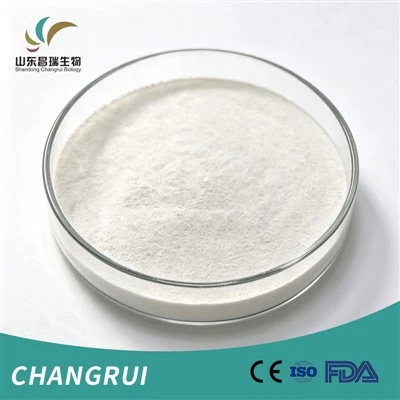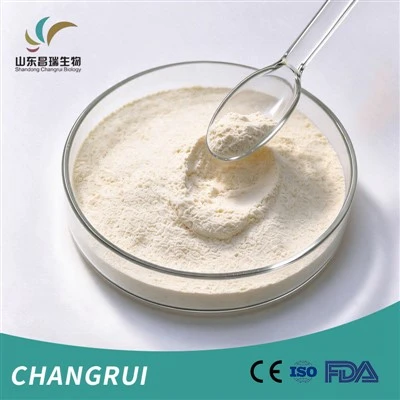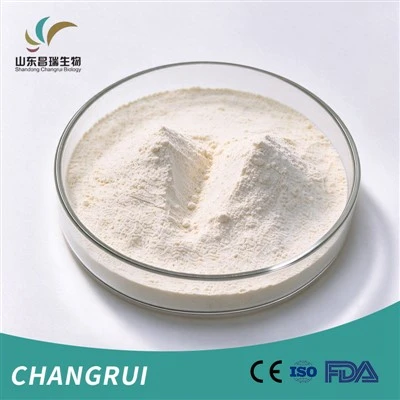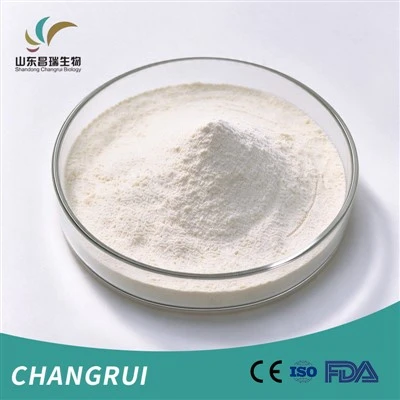
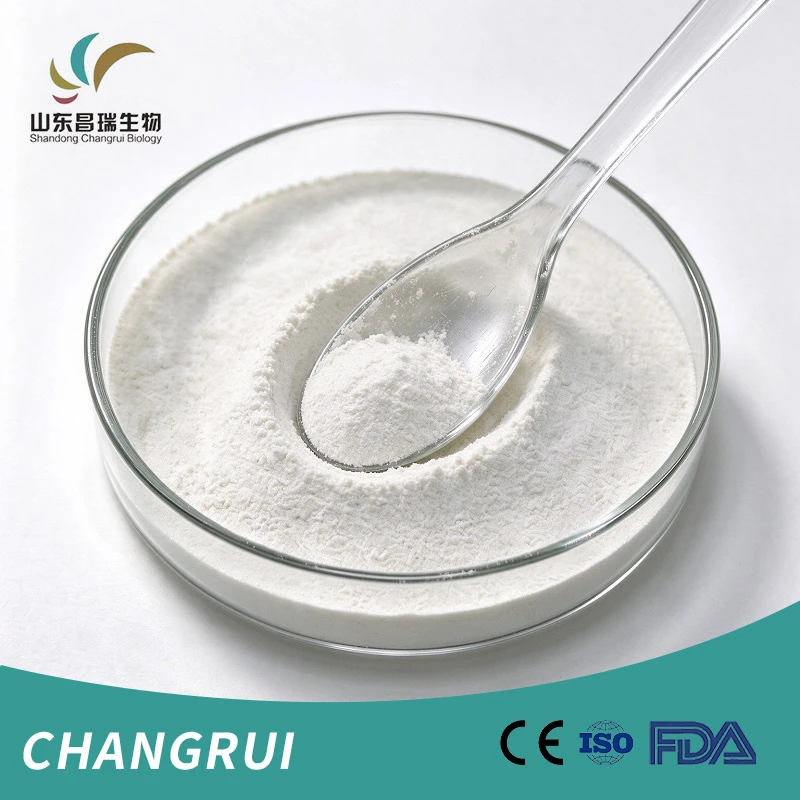
Shandong Changrui Biotech Co., Ltd. is one of the leading manufacturers and suppliers of chitin powder in China. Please feel free to wholesale bulk high purity chitin powder in stock here from our factory. All our raw materials are with high quality and competitive price. Contact us for pricelist.
Product Introduction
Chitin Powder is a natural nitrogen-containing polysaccharide featuring high chemical stability and mechanical strength. It remains insoluble in water, dilute acids and dilute alkalis. As a pharmaceutical excipient, it works as an inert tablet filler, sustained-release matrix reinforcer, microsphere substrate and tissue-engineering scaffold material. Benefiting from its chemical inertness and slow in-vivo degradation, it delivers reliable structural support for solid-dose and long-acting preparation development, offering developers a natural structural-focused excipient with filling, reinforcing and sustained-release capabilities.
Technical Specifications
|
Property |
Specification |
|
Appearance |
Off-white to white powder |
|
Assay |
98.0% min |
|
Deacetylation Degree |
20% max |
|
Moisture |
10.0% max |
|
Ash |
3.0% max |
|
Insoluble Matter |
1.0% max |
|
Lead (Pb) |
2 PPM max |
|
Arsenic (As) |
1 PPM max |
|
Total Plate Count |
3000 CFU/g max |
|
Mold & Yeast |
50 CFU/g max |
|
Coliforms |
0.3 CFU/g max |
|
Salmonella |
Negative |
Health Benefits & Values
High Chemical Inertness for Stable Formulation
High crystallinity minimizes chemical interaction with active ingredients, protecting formulation stability and extending shelf life under normal storage.
Superior Mechanical Reinforcement Capacity
Dense crystalline structure provides strong mechanical performance to strengthen composite matrix systems for solid dosage development.
Controlled Slow Biodegradation
Features slower in-vivo degradation than chitosan, releasing non-toxic saccharide metabolites to support long-term structural support requirements.
Excellent Biocompatibility for Biomaterial Contact
Low tissue irritation and rejection risk, suitable for oral excipient and tissue-contact biomaterial research with reliable biosafety.
Flexible Structural Processing Ability
Easily fabricated into porous scaffolds, microspheres and fibrous membranes to support cell adhesion and colonization for tissue engineering projects.
Core Value in Formulation Development
Inert Filler for Formulation Stability
As a chemically inert filler, chitin preserves formulation integrity during shelf-life by avoiding interactions with active ingredients.
Matrix Reinforcement for Release Modulation
When blended with chitosan and hypromellose, chitin improves the mechanical robustness of sustained-release matrices, indirectly modulating drug release profiles.
Microsphere and Scaffold Fabrication
Chitin Powder can be fabricated into microspheres, porous scaffolds, and fibrous membranes, expanding formulation options for drug delivery and tissue engineering.
Slow-Degrading Backbone for Long-Acting Designs
Its slow degradation supports formulations requiring prolonged structural support and extended in-vivo residence.
Compatibility with Common Excipients
Chitin is compatible with microcrystalline cellulose, lactose, magnesium stearate, and hypromellose in typical solid-dosage systems.
End-Application Scenarios
Inert Tablet Filler (Core)
Used in wet granulation and direct compression. Provides stable tablet weight and volume without reacting with actives.
Sustained-Release Matrix Reinforcement
Used in sustained-release tablets. Blended with chitosan and hypromellose. Enhances matrix mechanical integrity.
Microsphere, Scaffold, And Tissue Engineering Substrates
Fabricated into microspheres, porous scaffolds, and fibrous membranes for drug encapsulation and tissue-engineering research. Supports cell attachment and proliferation.
Supplementary Applications
Also used in water treatment flocculation, cosmetic film-forming/moisturizing, textile color-fixing, papermaking adhesives, and agricultural slow-release coatings.
Application Advantages and Market Positioning
Inert Structural Excipient Opens
Chitin Powder provides non-reactive structural support for formulations sensitive to excipient-active interactions.
Clear Differentiation versus Chitosan-Series Derivatives
Fills the market gap for non-dissolving reinforcing raw material.
Project-Enabling Option for Long-Acting and Regenerative Research
Supports long-release solid dosage and tissue-engineering prototype development.
Flexible Project-Oriented Customization
Customizable specifications adapt to diverse solid-formula and biomaterial research.
FAQ (Technical Q&A)
Q1: Is chitin the same as chitosan?
A: No. Chitin is the acetylated parent polysaccharide, insoluble in dilute acids. Chitosan is the deacetylated derivative, soluble in dilute acids.
Q2: What is the main role of chitin in solid dosage forms?
A: It serves as a chemically inert filler and matrix reinforcement material for tablets and capsules.
Q3: Can chitin be used for direct compression?
A: Yes, but its compressibility is lower than microcrystalline cellulose. It is often blended with other excipients for direct compression.
Q4: How does chitin behave in sustained-release tablets?
A: Its high crystallinity and mechanical strength reinforce the matrix structure, helping to modulate drug release.
Q5: Is chitin suitable for microsphere preparation?
A: Yes. It can be fabricated into microspheres and porous scaffolds for drug encapsulation and tissue-engineering research.
Q6: What is the typical particle size of your Chitin Powder?
A: Standard ≥80 mesh, customizable to 100 mesh or finer upon request.
Q7: How should chitin be stored?
A: Sealed, cool, dry, protected from light, away from strong acids and bases.
Q8: Can chitin be sterilized?
A: Yes. It tolerates ethylene oxide and gamma irradiation. Validation of molecular weight and viscosity changes is recommended.
Q9: Is chitin compatible with common excipients?
A: Compatible with microcrystalline cellulose, lactose, magnesium stearate, and hypromellose in typical solid-dosage systems.
Q10: What is the regulatory status of chitin?
A: Chitin is listed in major pharmacopoeias as a pharmaceutical excipient. It is not approved for injectable use.
Q11: What are the degradation products of chitin in vivo?
A: It degrades into oligosaccharides and glucosamine, which are metabolized by the body.
Q12: Can chitin be used in food or cosmetic applications?
A: Yes, it also finds use in water treatment, cosmetics, textiles, papermaking, and agricultural coatings.
Hot Tags: chitin powder, China chitin powder manufacturers, suppliers, factory