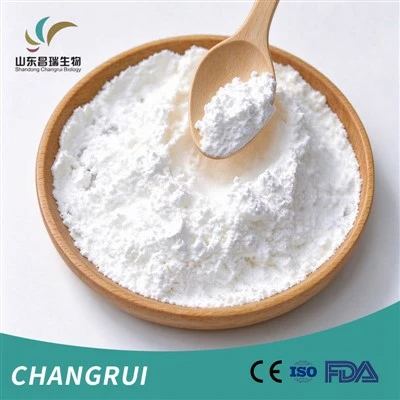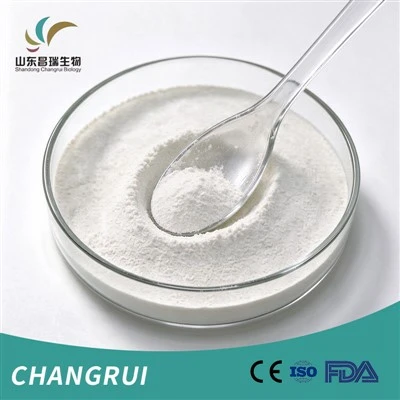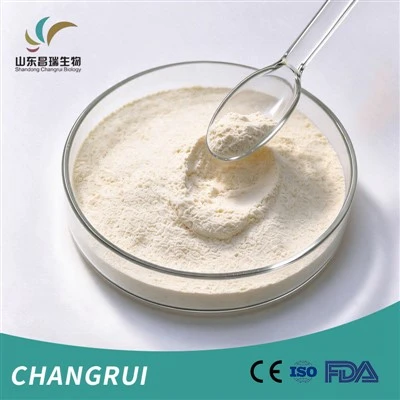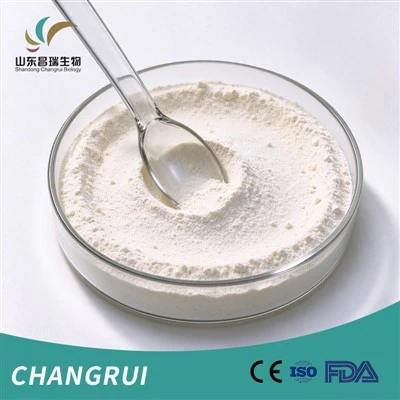
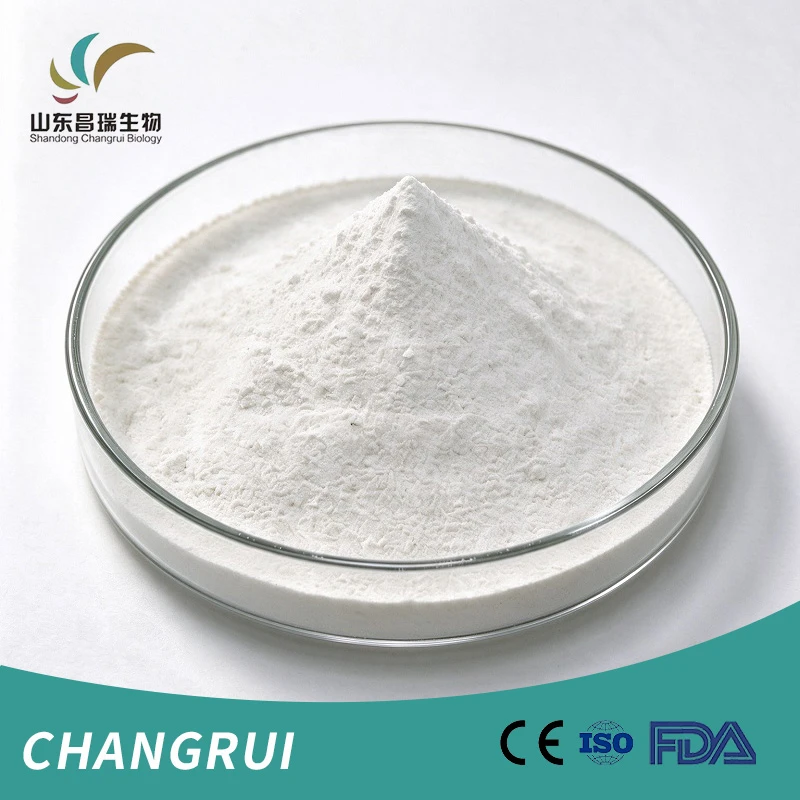
Shandong Changrui Biotech Co., Ltd. is one of the leading manufacturers and suppliers of high density chitosan in China. Please feel free to wholesale bulk high purity high density chitosan in stock here from our factory. All our raw materials are with high quality and competitive price. Contact us for pricelist.
Product Introduction
High Density Chitosan is a natural cationic polysaccharide distinguished by its high bulk density and exceptional powder flowability. It serves as multi-functional raw material usable for pharmaceutical excipient workflows and medical-device component fabrication. Optimized for solid-formulation processing, it supports capsule filling, direct compression, sustained-release matrices and inhalable carriers. Meanwhile, its compact particle architecture delivers exudate-absorbing, tissue-supporting and antimicrobial-relevant traits for wound dressings, scaffolds and implant-surface coatings, bringing distinctive processing-oriented and structural merits compared with conventional chitosan grades.
Technical Specifications
|
Property |
Specification |
|
Appearance |
Off-white powder |
|
Deacetylation Degree |
90% min |
|
Bulk Density |
0.6 g/cm³ min |
|
Viscosity (1% acetic acid, 25°C) |
20-500 mPa·s |
|
Moisture |
10.0% max |
|
Ash |
1.0% max |
|
Insoluble Matter |
1.0% max |
|
pH (1% solution) |
7.0-9.0 |
|
Arsenic (As) |
1 PPM max |
|
Lead (Pb) |
10 PPM max |
|
Mercury (Hg) |
0.2 PPM max |
|
Cadmium (Cd) |
1 PPM max |
|
Total Plate Count |
1000 CFU/g max |
|
Mold & Yeast |
100 CFU/g max |
|
E. coli |
Negative |
|
Salmonella |
Negative |
Health Benefits & Values
High Bulk Density Reduces Formulation Volume
Delivers high bulk density powder to cut occupied volume, enabling smaller capsule sizes and improving end-user swallowing experience for solid oral dosage.
Excellent Powder Flow Optimizes Manufacturing
Exhibits mild chemical inertness under normal storage, avoiding unwanted interactions with most excipients and active ingredients in solid dosage formulas.
Stable Compatibility With Solid Formulation Ingredients
Exhibits mild chemical inertness under normal storage, avoiding unwanted interactions with most excipients and active ingredients in solid dosage formulas.
Reliable Biosafety For Oral & Tissue Contact Use
Retains chitosan's natural non-toxic and biodegradable properties, meeting baseline safety requirements for oral excipient and medical device tissue-contact applications.
Acid-Triggered Gel Film Formation For Controlled Release
Forms protective gel networks in acidic environments, supporting sustained drug release and film-forming functions for wound-care and matrix tablet designs.
Core Value in Formulation Development
As Pharmaceutical Excipient
01 Capsule Filling: Reduces capsule shell size requirements and improves end-user swallowing experience for finished oral capsules.
02 Direct Compression: Cuts down extra excipient consumption and boosts throughput for high-speed tableting production workflows.
03 Sustained-Release Matrix: Enables flexible tuning of drug release kinetics within matrix-type sustained-release tablet systems.
04 Dry Powder Inhaler Carrier: Works as pulmonary delivery carrier to improve powder dispersibility for inhalation formulations.
05 Orally Disintegrating Tablets: Suited for fast-disintegrating oral tablet manufacture with acceptable sensory mouthfeel.
As Medical Device Material
06 Hemostatic Materials: High Density Chitosan suitable for manufacturing wound-sealing articles relying on exudate absorption performance.
07 Wound Dressings: Can be processed into wound-contact articles requiring film-forming and microbial-inhibiting functions.
08 Tissue Engineering Scaffolds: Provides enhanced mechanical baseline for cell-supporting three-dimensional scaffold constructs.
09 Absorbable Sutures: Supports fabrication of fibrous resorbable suture products with sufficient tensile strength.
10 Medical Antimicrobial Coatings: Fits surface-modification workflows for implant-related hardware to mitigate biofilm risks.
End-Application Scenarios
As Pharmaceutical Excipient
01 Capsule Filling (Core): Applied in high-volume capsule manufacturing to stabilise filling consistency.
02 Direct Compression: Deployed for high-speed tableting production lines for oral solid dosage forms.
03 Sustained-Release Formulations: High Density Chitosan used as matrix-forming raw input for sustained-release tablet development.
04 Dry Powder Inhalers: Used as carrier material in dry-powder inhalation product development.
05 Orally Disintegrating Tablets: Raw material for fast-disintegrating oral tablet finished goods.
As Medical Device Material
06 Hemostatic Materials: Production feedstock for hemostatic powder and sponge articles.
07 Wound Dressings: For hydrogel and fibre-membrane wound-contact dressing manufacture.
08 Tissue Engineering Scaffolds: For cartilage and bone repair-oriented scaffold fabrication.
09 Absorbable Sutures: Feedstock for resorbable surgical suture manufacturing.
10 Medical Antimicrobial Coatings: Surface-treatment material for catheters and stents.
Application Advantages and Market Positioning
Unique High-Bulk-Density Competitive Edge
Bulk density ≥0.6 g/cm³ differentiates it from standard low-bulk-density chitosan. It brings tangible volume-saving benefits especially for high-loading capsule product concepts.
Production-Oriented Merits for Solid-Dosage Manufacturing
Superior powder flow translates into practical manufacturing gains for capsule filling and direct-compression processes, lowering auxiliary excipient usage and raising factory efficiency.
Expanded Options for Medical-Device Design
Beyond pharma workflows, it expands design choices for wound-care and regenerative-medicine devices where mechanical performance of starting powder matters.
Dual-Domain Raw-Material Convenience
One single feedstock covers both pharmaceutical excipient and medical-device-material project demands, simplifying supplier management for multi-project customers.
FAQ (Technical Q&A)
As Pharmaceutical Excipient
Q1: Does high density chitosan cause static during capsule filling?
A: Less than standard chitosan due to its compact particle structure. Standard anti-static measures are usually sufficient.
Q2: Can it be used in direct compression without granulation?
A: Yes. Its flowability is sufficient. A lubricant such as magnesium stearate is recommended.
Q3: How does it compare to microcrystalline cellulose as a capsule filler?
A: It offers higher bulk density and lower volume per unit weight, reducing capsule size, plus additional gel-forming and bioadhesive functions.
Q4: Does it affect the dissolution rate of immediate-release tablets?
A: At low loading (5%–15%) it acts as binder/disintegrant and may slightly slow dissolution. Formulation optimization is recommended.
Q5: How to prevent sticking during tableting?
A: Use standard glidant/lubricant. Control humidity below 50%. Polishing punch surfaces also helps.
Q6: Is it suitable for enteric coating?
A: It dissolves in gastric acid and is not suitable alone. Combine with other polymers for pH-controlled release.
As Medical Device Material
Q7: How fast does it swell in hemostatic sponge applications?
A: It absorbs exudate rapidly and expands to form a physical barrier. Swelling rate depends on deacetylation degree and cross-linking. Typical expansion within 1–2 minutes.
Q8: How to control breathability and moisture retention in wound dressing films?
A: Adjust film thickness, plasticizer content, and blending ratio with other polymers. Thicker films reduce moisture vapor transmission; adding glycerol improves flexibility and moisture retention.
Q9: How does high density chitosan affect porosity and cell seeding in tissue engineering scaffolds?
A: Higher density reduces porosity. For cell seeding, balance is needed: use porogen leaching or freeze-drying to create interconnected pores while maintaining mechanical strength.
Q10: Is tensile strength sufficient for absorbable sutures?
A: Yes, when processed into fibers. Tensile strength depends on drawing ratio and post-treatment. Degradation rate can be tuned by deacetylation degree and molecular weight.
Q11: Which sterilization methods are compatible?
A: Ethylene oxide and gamma irradiation are compatible. Both may reduce molecular weight; validate viscosity and mechanical properties after sterilization.
Q12: How to ensure coating uniformity and adhesion in medical antimicrobial coatings?
A: Dissolve chitosan in dilute acid, apply by dip-coating or spraying, then neutralize to insolubilize. Surface pretreatment of the device improves adhesion.
Hot Tags: high density chitosan, China high density chitosan manufacturers, suppliers, factory