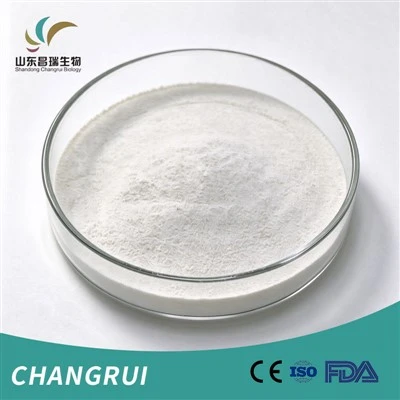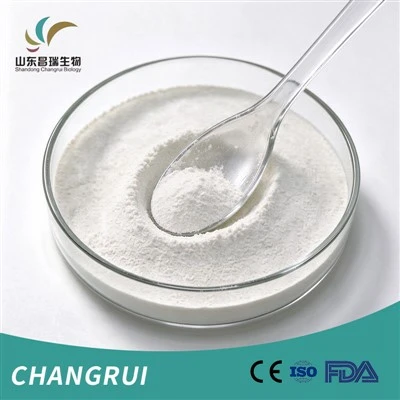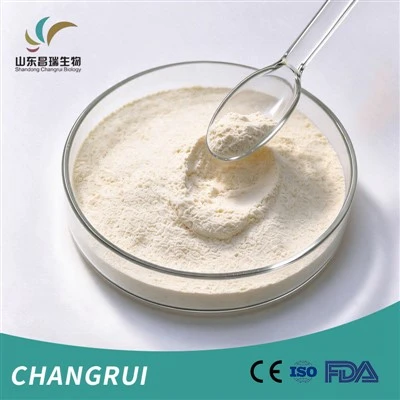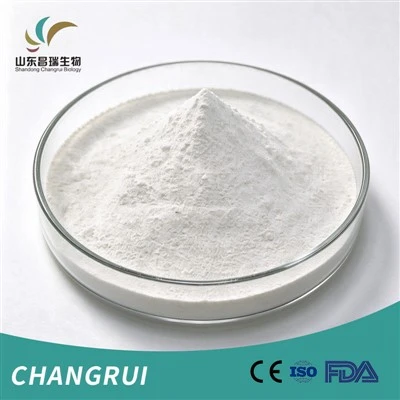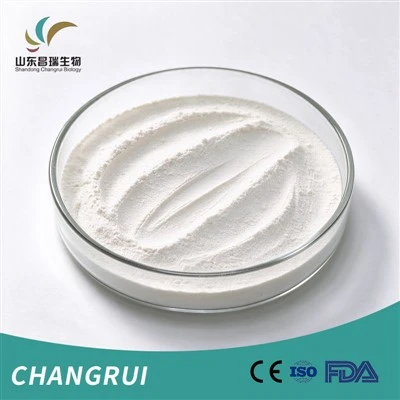
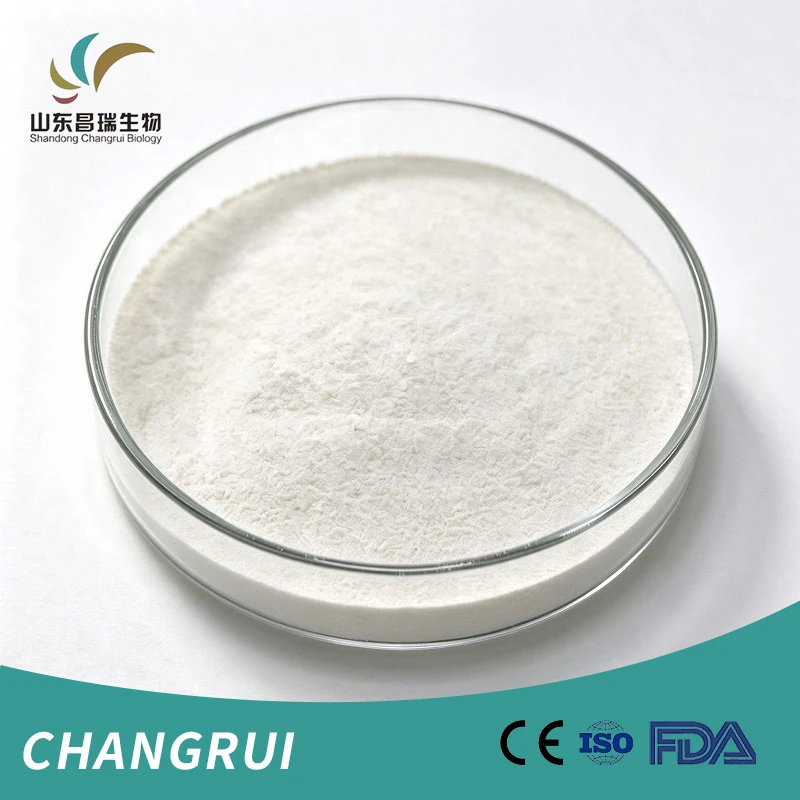
Shandong Changrui Biotech Co., Ltd. is one of the leading manufacturers and suppliers of pharmaceutical grade chitosan in China. Please feel free to wholesale bulk high purity pharmaceutical grade chitosan in stock here from our factory. All our raw materials are with high quality and competitive price. Contact us for pricelist.
Product Introduction
Pharmaceutical Grade Chitosan is a natural cationic polysaccharide derived from chitin through deacetylation. It is suitable for tablet binding and disintegrating, sustained-release matrices, nanoparticle carriers, wound dressings, and mucosal drug delivery systems. Its core value lies in excellent biocompatibility, biodegradability, and controllable drug release properties, enabling replacement of synthetic polymer excipients and development of safer, more efficient drug delivery systems, making it a multifunctional natural pharmaceutical excipient integrating binding, disintegrating, and sustained release in one ingredient.
Technical Specifications
|
Property |
Specification |
|
Appearance |
Off-white to white powder |
|
Deacetylation Degree |
90% min |
|
Viscosity (1% acetic acid, 25°C) |
20-500 mPa·s |
|
Moisture |
10.0% max |
|
Ash |
1.0% max |
|
Insoluble Matter |
1.0% max |
|
pH (1% solution) |
7.0-9.0 |
|
Residual Protein |
0.2% max |
|
Endotoxin |
100 EU/g max |
|
Heavy Metals (as Pb) |
10 PPM max |
|
Arsenic (As) |
1 PPM max |
|
Lead (Pb) |
0.5 PPM max |
|
Mercury (Hg) |
0.2 PPM max |
|
Cadmium (Cd) |
1 PPM max |
|
Total Plate Count |
1000 CFU/g max |
|
Mold & Yeast |
100 CFU/g max |
|
E. coli |
Negative |
|
Salmonella |
Negative |
Health Benefits & Values
Pharmacopoeia Standard Purity
Meets USP/EP pharmaceutical grade standards with strictly controlled endotoxin and heavy metal indicators, supporting global pharmaceutical registration and compliance.
Dual Tablet Functional Performance
Delivers both binding and disintegration properties for oral solid formulas, simplifying excipient combination and optimizing tablet production efficiency.
Tunable Drug Release Capacity
Adjustable molecular weight and viscosity support sustained-release, controlled-release and soluble-improvement formulation requirements for diversified drug development.
Stable Drug Delivery Carrier
Exhibits excellent electrostatic complexation ability to encapsulate active substances, enabling stable preparation of microspheres, nanoparticles and targeted delivery systems.
High Biosafety & Degradability
Features good tissue compatibility and complete in-vivo degradation, ensuring safe application for oral medicines, mucosal preparations and medical biomaterials.
Core Value in Formulation Development
Multi-functional Excipient to Simplify Formulation Layout
A single raw material can take on binding, disintegration, matrix-forming, and coating tasks in pharmaceutical formulas. It reduces excipient varieties and lowers overall procurement complexity.
Natural-Origin Substitute for Synthetic Polymers
As a bio-sourced cationic polymer, Pharmaceutical Grade Chitosan can partially replace synthetic polymer excipients including polyacrylic resins and PVP, helping manufacturers realize greener formulation concepts.
Tailorable Viscosity and Molecular-Weight Grades
Customizable viscosity-molecular-weight profiles match distinct dosage-form needs. High-viscosity variants suit gel-type matrices; low-viscosity lots fit particle fabrication; medium-viscosity material works for tableting workflows.
Broad Compatibility with Conventional Excipients
Works alongside microcrystalline cellulose, lactose, magnesium stearate, and hypromellose without generating undesirable interactive effects. Performance remains stable across acidic-to-neutral formulation environments.
Practical Storage and Handling Reminders
The material is hygroscopic and demands cool, sealed, dark storage to avoid caking. Dissolution requires dilute acetic or hydrochloric acid; prepared acidic solutions are best used freshly; strong-alkaline conditions should be avoided.
End-Application Scenarios
Tablet Binder and Disintegrant
Deployed for wet granulation and direct-compression processes. It improves tablet mechanical robustness while enabling fast disintegration upon fluid exposure. Typical loading is 1-10%, applicable for hormonal and anti-inflammatory oral solid products.
Sustained-Release and Controlled-Release Matrix Materials
Used within matrix-type sustained-release and controlled-release tablets. When blended with hypromellose, high-molecular-weight chitosan contributes to hydrated layer build-up to moderate drug liberation rates.
Nanoparticle and Microsphere Drug Delivery Systems
Fabricated into chitosan-based micro- and nanoparticles via cross-linking and spray-drying workflows for encapsulation of small-molecule, protein, and genetic payloads. Supports oral, nasal, pulmonary, and research-grade delivery.
Wound Dressings and Medical Biomaterials
Processed into sponges, hydrogels, and fibrous wound-care substrates. Its biomaterial properties are exploited for chronic-wound management and tissue-engineering scaffold building.
Mucoadhesive Formulations
Exploiting surface-adhesive characteristics for buccal patches, nasal gels, and vaginal delivery concepts to extend payload residence at mucosal sites and boost effective absorption.
Application Advantages and Market Positioning
Pharmacopoeia-Verified Regulatory Readiness
Streamlines regulatory submission workflows for pharmaceutical excipient registration.
Versatile Bio-Sourced Excipient Value Proposition
Pharmaceutical Grade Chitosan supports the industry shift toward natural-origin excipients.
Fully Customizable Molecular-Weight and Viscosity Options
Customizable molecular weight and viscosity grades cover diverse dosage form requirements.
Reliable Biological Safety Background
Reliable biological safety background for pharmaceutical development.
FAQ (Technical Q&A)
Q1: How long can a chitosan solution be stored before use?
A: Chitosan solutions in dilute acid are stable for 24–48 hours at room temperature. For longer storage, refrigerate at 2–8°C and re-test viscosity before use.
Q2: Does chitosan affect tablet color or stability when combined with colored actives?
A: Chitosan is off-white to pale yellow and generally does not cause discoloration. However, it may interact with anionic dyes; compatibility testing is recommended.
Q3: Can chitosan be used in direct compression?
A: Yes, but its compressibility is moderate. It is often blended with microcrystalline cellulose or lactose to improve tableting performance.
Q4: How does chitosan concentration affect wet granulation?
A: A 1%–3% chitosan solution in dilute acid is typical for wet granulation. Higher concentrations increase binder strength but may slow disintegration.
Q5: Can chitosan be used for enteric coating?
A: Chitosan dissolves in gastric acid and is not suitable for enteric coating alone. It can be combined with other polymers for pH-controlled release.
Q6: What is the typical particle size range of chitosan nanoparticles?
A: Chitosan nanoparticles are typically 100–500 nm, depending on molecular weight, concentration, and cross-linker ratio.
Q7: How to prevent aggregation during freeze-drying of chitosan nanoparticles?
A: Add cryoprotectants such as trehalose or mannitol before freezing. Optimize freezing rate and drying cycle to maintain redispersibility.
Q8: Does chitosan interact with protein drugs during encapsulation?
A: Chitosan can electrostatically bind proteins. This can be beneficial for loading but may affect protein conformation. Stability testing is required.
Q9: How does deacetylation degree affect nanoparticle formation?
A: Higher deacetylation increases cationic charge, promoting stronger ionic cross-linking and smaller nanoparticles.
Q10: What sterilization methods are compatible with chitosan?
A: Ethylene oxide and gamma irradiation are commonly used. Both may reduce molecular weight; validation of viscosity and sterility is recommended.
Q11: Can Pharmaceutical Grade Chitosan be used in orally disintegrating tablets?
A: Yes, it can act as a binder and disintegrant. Its taste is mild, and it can be combined with superdisintegrants for faster breakdown.
Q12: How to control the release rate of chitosan-based sustained-release matrices?
A: Adjust molecular weight, viscosity, and ratio with hypromellose. Higher molecular weight and higher chitosan content generally slow release.
Hot Tags: pharmaceutical grade chitosan, China pharmaceutical grade chitosan manufacturers, suppliers, factory