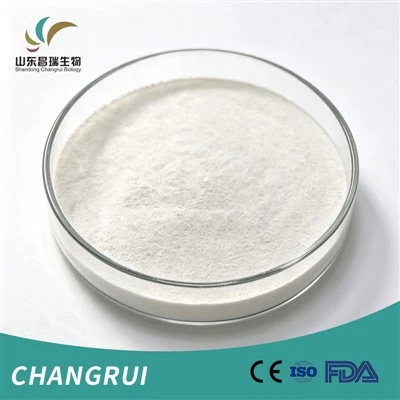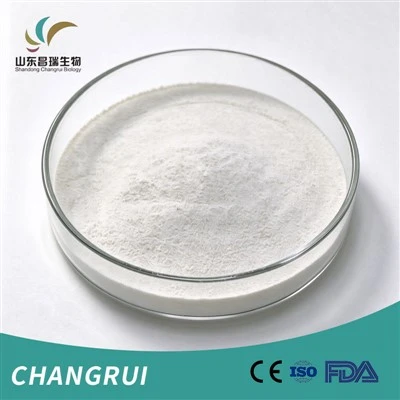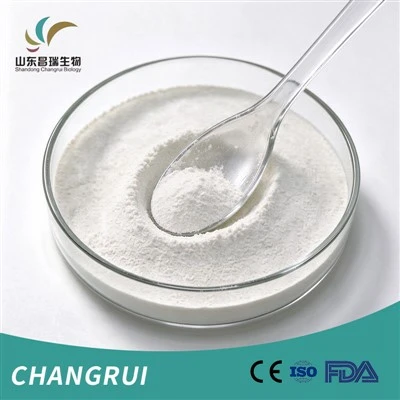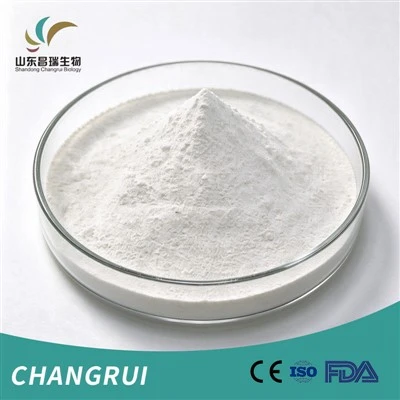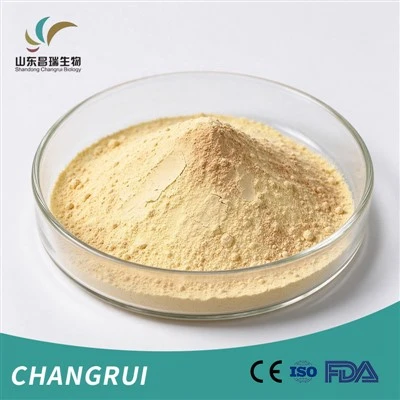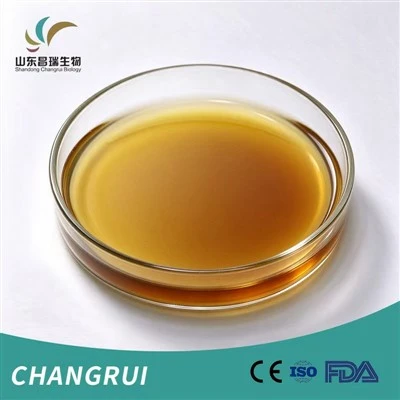
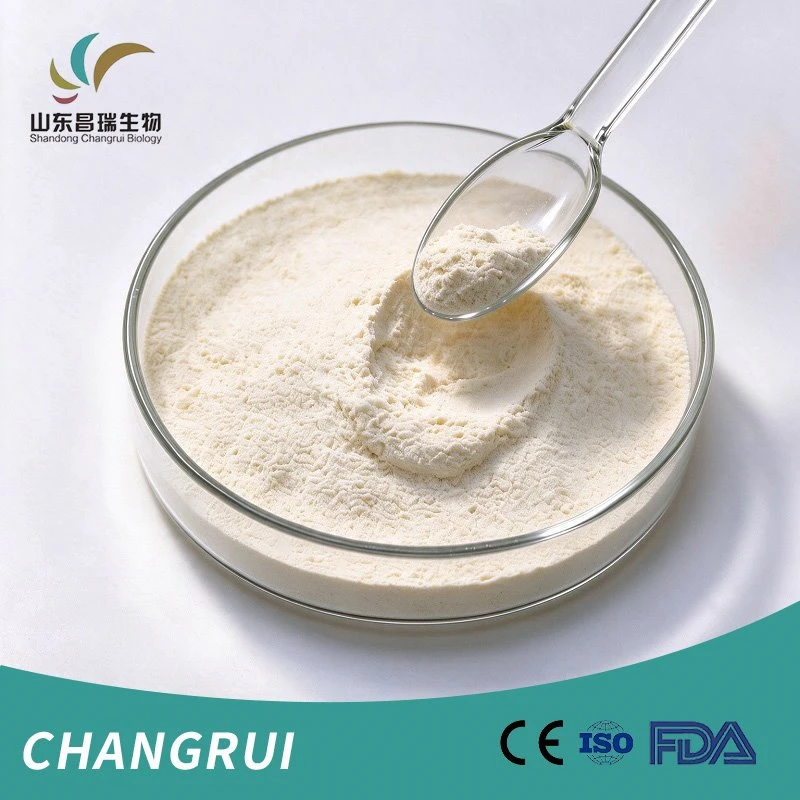
Shandong Changrui Biotech Co., Ltd. is one of the leading manufacturers and suppliers of low molecular weight chitosan in China. Please feel free to wholesale bulk high purity low molecular weight chitosan in stock here from our factory. All our raw materials are with high quality and competitive price. Contact us for pricelist.
Product Introduction
Low Molecular Weight Chitosan is obtained via enzymatic or chemical degradation of chitosan. Unlike conventional chitosan, it dissolves directly in water without dilute acid. It delivers pronounced mucoadhesion and absorption-promoting effects, ideal for liquid formulations, mucosal drug delivery, nanoparticle carriers and R&D-stage injectable-related delivery research. It solubilizes poorly soluble active ingredients and simplifies liquid dosage form manufacturing, serving as a natural oligosaccharide excipient combining aqueous solubility, mucoadhesion and bioavailability enhancement.
Technical Specifications
|
Property |
Specification |
|
Appearance |
Pale yellow to off-white powder |
|
Deacetylation Degree |
90% min |
|
Molecular Weight |
5,000 Da max |
|
Moisture |
10.0% max |
|
Ash |
1.0% max |
|
Insoluble Matter |
1.0% max |
|
pH (1% solution) |
4.0-7.0 |
|
Arsenic (As) |
1 PPM max |
|
Lead (Pb) |
2 PPM max |
|
Mercury (Hg) |
0.5 PPM max |
|
Cadmium (Cd) |
1 PPM max |
|
Total Plate Count |
1000 CFU/g max |
|
Mold & Yeast |
50 CFU/g max |
|
E. coli |
Negative |
|
Salmonella |
Negative |
Health Benefits & Values
Direct Water Solubility Simplifies Liquid Production
Features excellent pure-water solubility without acetic acid dissolution, greatly simplifying liquid formulation processes and lowering manufacturing costs.
Mucosal Adhesion Boosts Drug Bioavailability
Delivers stable electrostatic mucosal binding to prolong drug residence time, effectively improving absorption efficiency for mucosal delivery formulations.
Solvent-Free Green Particle Forming Capacity
Enables ionic cross-linking and self-assembly in pure water, supporting green preparation of micro/nano carriers without organic solvent addition.
Excellent Dispersion & Solubilization Enhancement
Optimizes interfacial tension of hydrophobic actives, significantly improving dispersion stability and solving poor solubility challenges in aqueous formulas.
Safe & Metabolizable Low-Molecular Biosafety
Retains superior chitosan-series biocompatibility with small molecular fragments, ensuring safe in-vivo degradation and absorption for high-bioavailability formula design.
Core Value in Formulation Development
Water-Solubility Advantage Streamlines Liquid-Formulation Workflows
Direct water-solubility removes the necessity for dilute-acid solubilisation steps for oral-liquid, nasal-drop and eye-drop production. It cuts down process complexity and associated manufacturing expenditures for liquid-dosage-form projects.
Mucosal-Interaction Property to Lift Payload Bioavailability
Mucosal-surface association extends payload residence duration at oral-nasal-ocular mucosal sites while facilitating epithelial-barrier crossing, offering clear benefits for mucosal-delivery-system concept development.
Aqueous-Phase Particle Fabrication as Synthetic-Solubiliser Alternative
Particulate constructs can be built fully within aqueous environments without organic-solvent addition. It can partially replace synthetic solubilising additives, aligning with natural-ingredient-oriented green-formulation tendencies.
Low-Molecular-Weight Supports Ready Biological Processing
Grades can be custom-tailored down to ≤3,000 Da or ≤1,000 Da. Shorter chain lengths facilitate biological absorption-metabolism, suiting high-bioavailability oral-liquid and nanoparticle-delivery-system designs.
Broad Compatibility with Mainstream Excipient Families
Works compatibly alongside microcrystalline cellulose, lactose and hypromellose without undesired interactive phenomena. Performance maintains stability across acidic-to-neutral formulation-pH ranges, granting broad formulation adaptability.
End-Application Scenarios
Liquid Formulations and Oral Liquids (Core Track)
Deployed for oral-liquid preparations, drops and syrup-type finished formulations. Usual recommended loading: 1-10%.
Mucosal Drug Delivery Systems
Deployed for nasal-spray, buccal-patch and ocular-drop formulation development.
Nanoparticle and Microsphere Drug Delivery Systems
Applied for nanoparticle, microsphere and microcapsule fabrication for small-molecule, protein and genetic-material payload encapsulation; suitable for oral, mucosal and R&D-stage delivery research.
Research-Grade Injectable-Related Excipients
Serves as raw material for research-grade nanoparticle-microsphere production at the research and development stage. For final injectable products, further control of endotoxin and microbial indicators is required based on target regulatory requirements.
Solubilization of Poorly Soluble Drugs
Used for oral-liquid and solid-dispersion systems targeting poorly-soluble hydrophobic actives.
Supplementary Applications (Non-Pharmaceutical Excipient)
Low Molecular Weight Chitosan also finds secondary deployment for food-preservation, cosmetic moisturising-film-forming ingredients, agricultural biological-control agents and water-treatment flocculation feedstock.
Application Advantages and Market Positioning
Unique Direct Water-Soluble Trait among Chitosan Family
Distinct from conventional acid-soluble high-molecular-weight chitosan, this low-molecular-weight variant dissolves in plain water without acid addition. It lowers process barriers specifically for liquid-oriented formulation projects.
Target-Oriented Mucosal-Delivery-Focused Excipient
Differentiated vs chitosan hydrochloride / thiolated chitosan: it delivers moderate electrostatic mucoadhesion without covalent cross-linking behaviour. Balanced performance suits liquid mucosal formulations where strong covalent bonding is unnecessary.
Expanded Technical Options for Green Formulation Design
Enables organic-solvent-free nanoparticle manufacturing, offering a natural alternative to synthetic solubilisers for green formulation projects.
Highly Customisable Molecular-Weight Grades
Molecular-weight, deacetylation-degree and particle-size distribution can all be adjusted following client formulation-project requirements, covering diverse dosage-form technical constraints.
FAQ (Technical Q&A)
Q1: How should Low Molecular Weight Chitosan be dissolved for formulation use?
A: Dissolve directly in water at 1%–5% w/v with gentle stirring at room temperature. No acid is required. Filter the solution if clarity is critical.
Q2: Can the chitosan solution be autoclaved?
A: Not recommended. High heat may reduce molecular weight and viscosity. Use 0.22 µm sterile filtration or aseptic handling instead.
Q3: How stable is the aqueous solution during processing?
A: Stable for short periods at pH 4–7. Avoid high temperature and alkaline conditions. For longer processing, keep refrigerated at 2–8°C and use within days.
Q4: Can it be used for injectable-related formulation research?
A: Research-grade material with endotoxin ≤100 EU/g can be used for R&D. Final injectable products require further endotoxin and microbial control based on target regulations.
Q5: How does it interact with protein or peptide drugs?
A: It may bind proteins electrostatically. Compatibility and stability testing are recommended before scaling up.
Q6: How are nanoparticles prepared using this product?
A: Via ionic cross-linking with sodium tripolyphosphate in pure water under stirring. Particle size can be adjusted by concentration and cross-linker ratio.
Q7: Can it improve the dissolution of poorly soluble drugs?
A: Yes. As a hydrophilic carrier or solid dispersion matrix, it improves wetting and dissolution rate.
Q8: Is it suitable for ocular or nasal formulations?
A: Yes, its mucoadhesive property supports ocular and nasal delivery. Formulations should be sterile, isotonic, and pH-adjusted.
Q9: Does it affect taste in oral liquids?
A: It has a slight taste. Flavor masking may be needed for taste-sensitive products.
Q10: What is the compatibility with anionic excipients?
A: It may interact with anionic polymers or surfactants. Compatibility testing is required before use.
Q11: What molecular weight grades are available?
A: ≤5,000 Da as standard; custom grades ≤3,000 Da or ≤1,000 Da are available.
Q12: Can Low Molecular Weight Chitosan be used in solid dosage forms?
A: Yes. It can act as a binder or solubilizer in tablets and capsules.
Hot Tags: low molecular weight chitosan, China low molecular weight chitosan manufacturers, suppliers, factory