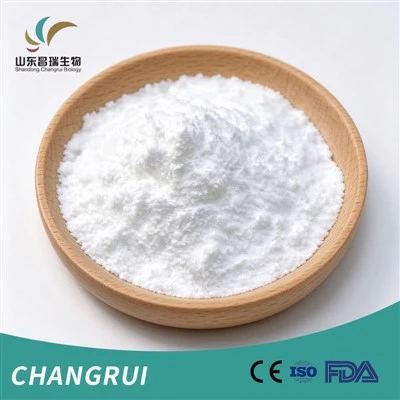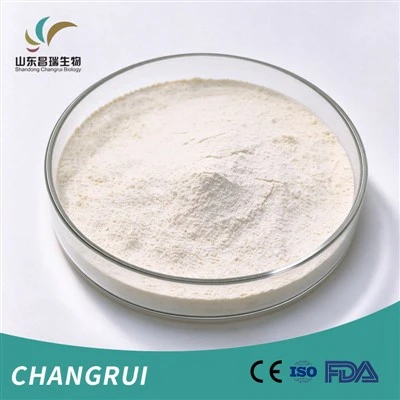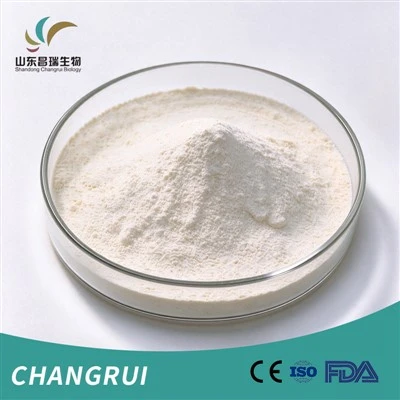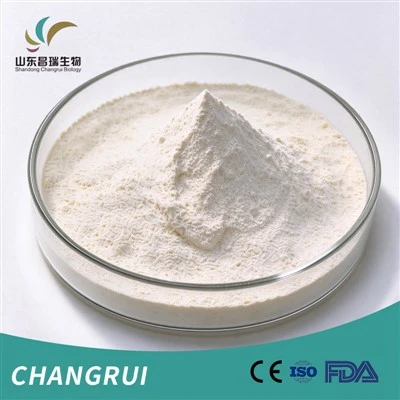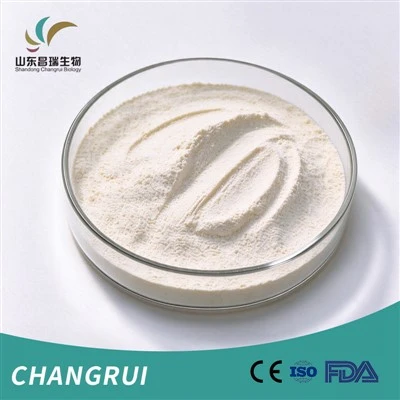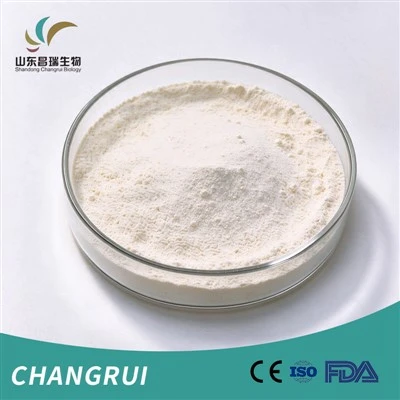
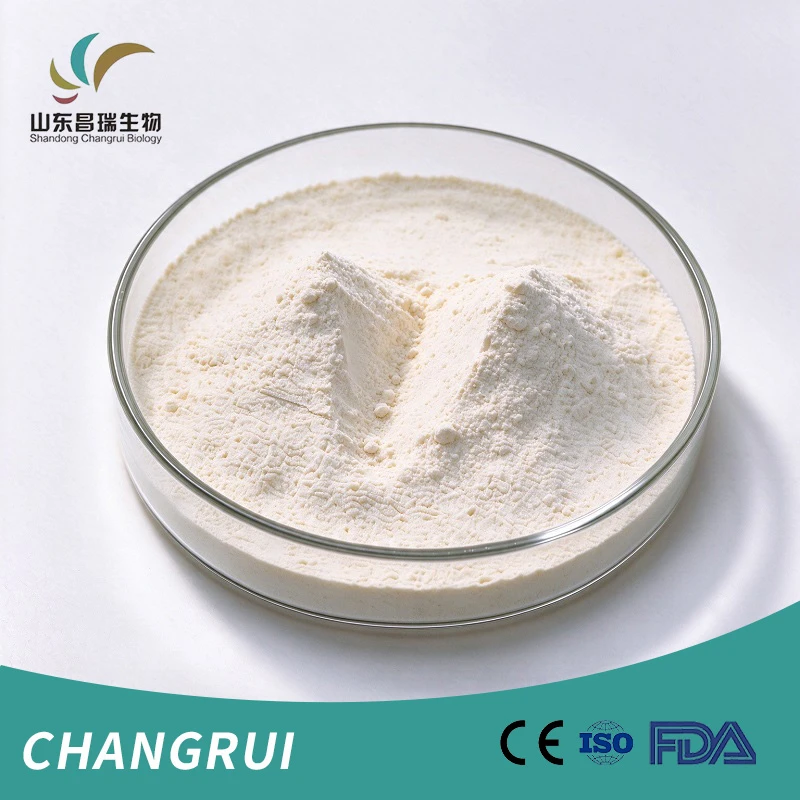
Shandong Changrui Biotech Co., Ltd. is one of the leading manufacturers and suppliers of chitosan lactate in China. Please feel free to wholesale bulk high purity chitosan lactate in stock here from our factory. All our raw materials are with high quality and competitive price. Contact us for pricelist.
Product Introduction
Chitosan Lactate is a cationic chitosan salt formed by protonating chitosan with lactic acid. It dissolves directly in neutral water without dilute acid. This multi-functional excipient is used for sustained-release matrix tablets, mucosal drug delivery systems, wound dressings and liquid preparations. Its standout neutral-water solubility and excellent film-forming properties enable flexible formulation design for pharmaceutical and biomaterial research.
Technical Specifications
|
Property |
Specification |
|
Appearance |
Pale yellow to off-white powder |
|
Deacetylation Degree |
80-98% |
|
Viscosity (1% solution, 25°C) |
5 mPa·s min |
|
Moisture |
10.0% max |
|
Ash |
1.0% max |
|
Insoluble Matter |
2.0% max |
|
pH (1% solution) |
3.0-7.0 |
|
Residual Protein |
0.5% max |
|
Arsenic (As) |
0.5 PPM max |
|
Lead (Pb) |
40 PPM max |
|
Mercury (Hg) |
0.2 PPM max |
|
Cadmium (Cd) |
0.5 PPM max |
|
Total Plate Count |
1000 CFU/g max |
|
Mold & Yeast |
100 CFU/g max |
|
E. coli |
Negative |
|
Staphylococcus aureus |
Negative |
|
Pseudomonas aeruginosa |
Negative |
|
Salmonella |
Negative |
Health Benefits & Values
Neutral Water Solubility Streamlines Liquid Formulation
Dissolves directly in neutral aqueous media to form clear solutions, eliminating acid dissolution steps and protecting acid-sensitive active ingredients.
Tunable Gel Network for Custom Controlled Release
Self-assembles into hydrated gel networks upon contact with water. Adjustable network strength enables flexible drug release tuning for matrix tablet designs.
Cationic Mucosal Affinity Boosts Mucosal Absorption
Positively charged segments bind to mucosal surfaces electrostatically, extending payload residence time and improving penetration for mucosal delivery systems.
Breathable Flexible Film-Forming Performance
Creates moisture-permeable thin films after solvent evaporation, Chitosan Lactate is ideal for wound contact materials, tablet coating and cosmetic film-forming applications.
Safe Gradual Biodegradation In Vivo
Degrades slowly within biological systems into harmless oligosaccharides, glucosamine and lactate, supporting oral and tissue-contact biomaterial development.
Core Value in Formulation Development
Simplify Liquid Formulation Production
No acetic acid is required for dissolution in neutral water, cutting production steps and preventing incompatibility with acid-sensitive active ingredients.
Adjustable Matrix for Controlled Release
Used as hydrophilic matrix material to regulate drug release kinetics in matrix tablets. Release profiles can be tailored by adjusting loading amount and molecular weight.
Prolong Mucosal Retention for Absorption Improvement
Extends residence time on mucosal surfaces to facilitate substance penetration, supporting formulation development for peptide and vaccine mucosal delivery.
Functional Film for Wound Contact Materials
Fabricated into breathable protective films for wound care and cosmetic applications.
Broad Excipient Compatibility
Compatible with common pharmaceutical excipients such as MCC, lactose and HPMC without adverse interactions.
End-Application Scenarios
Sustained-Release Matrix Tablets (Core Track)
Manufacture of hydrophilic matrix sustained-release tablets. Recommended loading range: 10%-40%.
Mucosal Drug Delivery Systems
Raw material for nasal sprays and buccal patches, suitable for peptide and vaccine nasal delivery. Recommended dosage: 1%-10%.
Wound Dressings and Skin Care
Produce sponges, hydrogel dressings and nanofibre membranes for chronic wounds, burns and surgical incision care.
Liquid Formulations and Film Coating
Applied in oral liquids, drop formulations and film coating for tablets and granules.
Supplementary Applications (Non-Pharmaceutical Excipient)
Applicable for cosmetic film-forming raw materials, food preservation additives and agricultural biocontrol materials.
Application Advantages and Market Positioning
Unique Neutral Water-Soluble Chitosan Salt
Different from conventional chitosan which only dissolves in dilute acid, it dissolves directly in neutral aqueous media and simplifies formulation processing for liquid and mucosal delivery projects.
Multi-Functional Single Excipient
Integrates matrix-forming, mucosal affinity and film-forming properties in one raw material, reducing the number of excipients in formulation design.
Ideal Candidate for Mucosal & Sustained Release Projects
Chitosan Lactate is well suited for developers working on mucosal delivery systems and sustained-release oral matrix tablets.
Flexible Customization Service
Viscosity, deacetylation degree and particle size can be customized to match diverse dosage form requirements.
FAQ (Technical Q&A)
Q1: How should it be dissolved for formulation use?
A: Dissolve directly in neutral water at 1%–5% w/v with stirring at room temperature. No acid required. Filter if clarity is critical.
Q2: How stable is the aqueous solution during processing?
A: Stable at pH 5–8 for short periods. Avoid high temperature and extreme pH. Refrigerate at 2–8°C for longer processing.
Q3: How to control gel strength in sustained-release matrix tablets?
A: Adjust the ratio to hypromellose and total polymer loading. Higher chitosan lactate content generally accelerates gel formation but may increase release rate.
Q4: What are the key considerations for mucosal drug delivery formulations?
A: Maintain pH 5–7 for optimal mucosal adhesion. Sterile filtration is recommended for nasal and ocular applications. Avoid preservatives that may interact with the cationic polymer.
Q5: How does it perform in film coating applications?
A: It forms clear, flexible films. Adding plasticizer such as glycerol improves flexibility. Avoid high humidity during drying.
Q6: Is it compatible with anionic excipients or actives?
A: It may form complexes with anionic polymers or drugs. Compatibility testing is recommended before scaling up.
Q7: How is wound dressing film prepared using Chitosan Lactate?
A: Dissolve in water, cast or spray onto a substrate, then dry. Adding glycerol improves flexibility. Cross-linking with genipin enhances wet strength.
Q8: What is the swelling behavior of hemostatic sponges made from this material?
A: Swelling ratio is typically 200%–500% depending on cross-linking. It can be tuned for different wound types by adjusting deacetylation and cross-linker level.
Q9: How to control pore size in tissue engineering scaffolds?
A: Use freeze-drying or porogen leaching. Pore size is controlled by freezing temperature or porogen particle size. Typical range: 50–300 μm.
Q10: Which sterilization methods are compatible?
A: Ethylene oxide and gamma irradiation are compatible. Both may reduce molecular weight; validate viscosity and mechanical properties after sterilization.
Q11: Can it be used for injectable hydrogel systems?
A: Yes. It can form in-situ gels via pH adjustment or ionic cross-linking. Gel time depends on concentration and cross-linker ratio. Sterile filtration is required.
Q12: How to prevent post-surgical adhesion effectively?
A: Chitosan Lactate apply as a gel or film at the surgical site. It forms a protective barrier between tissue layers. Ensure complete coverage and adequate residence time.
Hot Tags: chitosan lactate, China chitosan lactate manufacturers, suppliers, factory