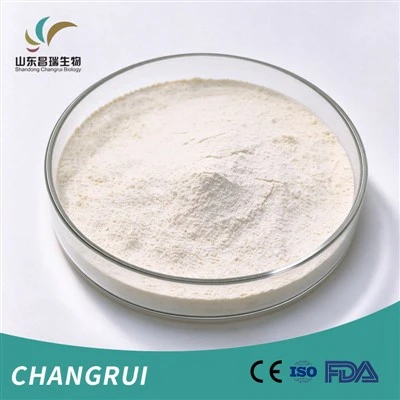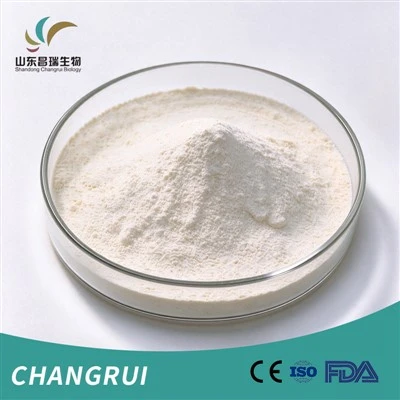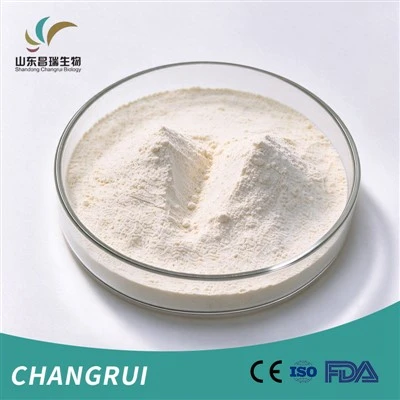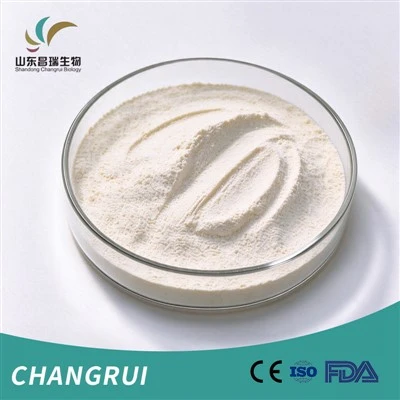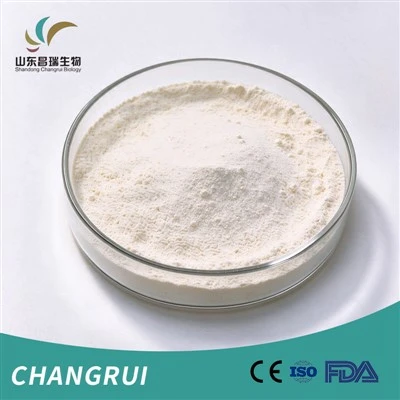
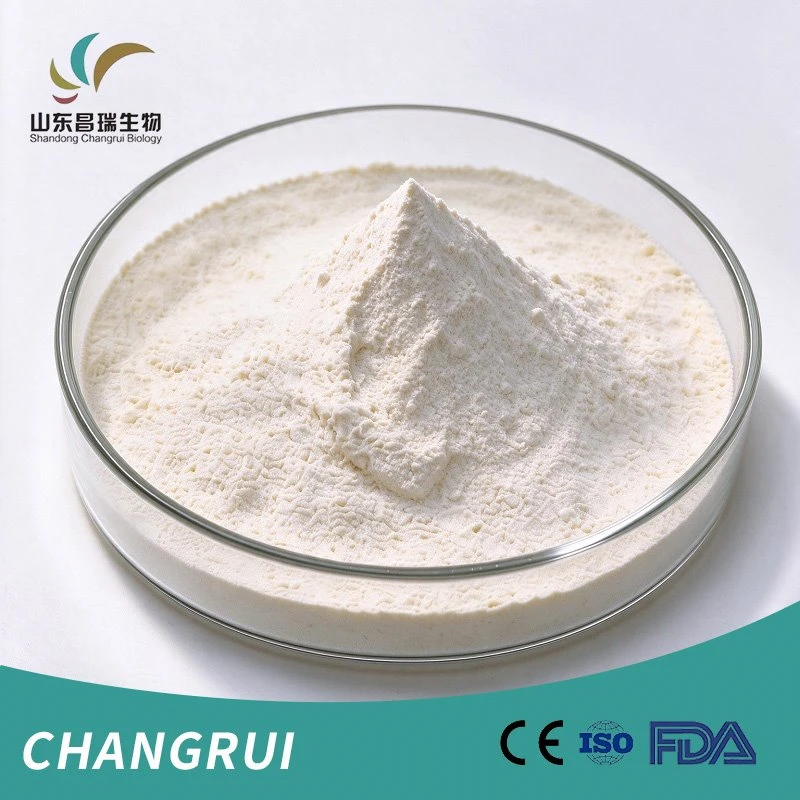
Shandong Changrui Biotech Co., Ltd. is one of the leading manufacturers and suppliers of hydroxypropyl chitosan powder in China. Please feel free to wholesale bulk high purity hydroxypropyl chitosan powder in stock here from our factory. All our raw materials are with high quality and competitive price. Contact us for pricelist.
Product Introduction
Hydroxypropyl Chitosan Powder is a water-soluble polysaccharide modified via hydroxypropylation, serving as a dual-purpose raw material for pharmaceutical excipients and medical-device manufacturing. It stands out for its full-pH aqueous solubility alongside optional alcohol-soluble custom grades, while native amino-group activity remains well-preserved. This versatile feedstock accommodates a wide spectrum of formulation needs, ranging from permeation-modulating drug systems to advanced injectable biomaterial constructs.
Technical Specifications
|
Property |
Specification |
|
Appearance |
Pale yellow to off-white powder |
|
Degree of Substitution |
0.8 min |
|
Viscosity (1% solution, 25°C) |
10-200 mPa·s |
|
Moisture |
15.0% max |
|
Ash |
1.0% max |
|
Insoluble Matter |
1.0% max |
|
pH (1% solution) |
6.0-8.0 |
|
Residual Protein |
0.5% max |
|
Arsenic (As) |
1 PPM max |
|
Lead (Pb) |
10 PPM max |
|
Mercury (Hg) |
0.2 PPM max |
|
Cadmium (Cd) |
1 PPM max |
|
Total Plate Count |
1000 CFU/g max |
|
Mold & Yeast |
100 CFU/g max |
|
E. coli |
Negative |
|
Salmonella |
Negative |
|
Staphylococcus aureus |
Negative |
|
Pseudomonas aeruginosa |
Negative |
Health Benefits & Values
Full-pH & Optional Alcohol Solubility Expands Formulation Possibilities
Dissolves stably across acidic-neutral-alkaline aqueous media, with custom grades compatible with alcohol solvents, offering greater flexibility for diverse formulation designs.
Preserved Amino Activity Retains Native Biological Functions
Modification occurs mainly on hydroxyl sites, keeping amino groups intact to maintain the original biological interaction performance of chitosan.
Biomembrane Interaction & Self-Assembled Gel Network Capacity
Interacts with biological barrier surfaces and forms crosslinked gel networks upon hydration, supporting sustained-release carrier and biomaterial development.
Self-Repairable Film & Moisturising Functionality
Forms continuous thin films and provides moisturising effects. Hydrogen bonding enables self-healing hydrogel systems for wound care and coating applications.
Low-Irritation & Gradually Degradable Biomaterial
Features minimal skin irritation and undergoes slow biological breakdown in vivo, safe for topical, oral and tissue-contact medical device applications.
Core Value in Formulation Development
As Pharmaceutical Excipient
01 Permeation-Enhancing Sustained-Release Carrier: Delivers barrier-modulating effects to improve payload transport across mucosa or skin, while functioning as gel-matrix material to realise gradual payload liberation.
02 Gel Matrix Tablets: Hydroxypropyl Chitosan Powder works as hydrophilic matrix constituent to achieve sustained payload release via swelling-erosion mechanisms, well-suited for formulation projects involving model active substances.
03 Microspheres and Nanoparticles: Can be processed into micro- and nano-particles to encapsulate protein-type bioactive actives for oral-delivery purposes.
04 Solubilization of Poorly Soluble Drugs: Improves aqueous system compatibility, enhancing wetting behaviour and dissolution performance for hard-to-solubilise actives.
05 Film Coating: Exhibits favourable film-forming performance for tablet and granule surface finishing, optimising visual appearance and tuning sustained-release behaviour.
As Medical Device Material
06 Injectable Self-Healing Hydrogels: Can be compounded with ε-polylysine to produce injectable self-reparable hydrogels and expand technical options for wound-repair device design.
07 Wound Repair Dressings: Processable into sponges, films and hydrogel articles to manage burn-lesion, chronic-ulcer and other hard-to-heal wound cases.
08 Antimicrobial Hemostatic Materials: Can be formulated into powder, sponge and antimicrobial dressings that combine microbial suppression and exudate absorption to build physical wound-sealing barriers.
09 Tissue Engineering Scaffolds: Supports cell attachment and proliferation, serving as scaffold raw material for skin-repair and cartilage-regeneration projects.
10 Medical Antimicrobial Coatings: Adaptable for surface modification of catheters and implant hardware to restrain bacterial attachment and biofilm accumulation.
End-Application Scenarios
As Pharmaceutical Excipient
01 Permeation-Enhancing Sustained-Release Carrier (Core): Deployed for oral or topical formulation projects requiring barrier-modulation and sustained-liberation performance, including skin-care and hair-care topical systems.
02 Gel Matrix Tablets: Used for sustained-release tablet development with model active substances as hydrophilic matrix raw-material.
03 Microspheres and Nanoparticles: Acts as oral-delivery carrier feedstock for protein-type bioactive actives.
04 Solubilization of Poorly Soluble Drugs: Applied to boost dissolution and bioavailability for hard-to-solubilise payload substances.
05 Film Coating: Used in tablet and granule surface-coating manufacturing workflows.
As Medical Device Material
06 Injectable Self-Healing Hydrogels: Applied to develop injectable gel-systems for infected-wound repair and soft-tissue-filling use-cases.
07 Wound Repair Dressings: Manufacture of sponge, film and hydrogel-type dressings targeting burn-wound and chronic-ulcer lesions.
08 Antimicrobial Hemostatic Materials: Production of exudate-absorbing powder, sponge and antimicrobial wound-care finished goods.
09 Tissue Engineering Scaffolds: Scaffold feedstock for skin-repair and cartilage-regeneration projects.
10 Medical Antimicrobial Coatings: Surface-treatment material for catheters and stents to realise anti-biofilm performance.
Application Advantages and Market Positioning
Formulation Flexibility Brought by Dual-Solubility Profile
Hydroxypropyl Chitosan Powder is unique dual-solubility profile combining full-pH aqueous solubility and optional alcohol-soluble grades creates clear differentiation versus water-only-soluble carboxymethyl chitosan and chitosan hydrochloride. It greatly broadens feasible technical routes for formulation developers.
Competitive Edge from Retained Native Amino-Group Activity
Hydroxypropylation mainly reacts at hydroxyl positions. Retained amino-group-related bio-activity distinguishes this material from carboxymethyl chitosan with lowered amino-activity after modification, as well as unmodified high-cation chitosan hydrochloride.
Practical Benefits for Pharmaceutical Development
It opens reliable technical pathways for barrier-modulation design and gel-matrix tablet manufacturing. It improves dissolution behaviour for hard-to-solubilise substances while keeping intrinsic biological functions intact.
Multi-Dimensional Value for Medical-Device Projects
It enables the development of injectable self-healable hydrogels and diversified wound-care articles, meeting combined requirements for microbial suppression, exudate management and moisturising effects in burn-and-ulcer wound-care scenarios.
FAQ (Technical Q&A)
As Pharmaceutical Excipient
Q1: How does the degree of hydroxypropylation affect solubility?
A: Higher substitution increases water solubility and alcohol solubility. At ≥0.8 substitution, it is fully water-soluble; some grades also dissolve in ethanol.
Q2: How can I verify that amino groups remain intact?
A: Use ninhydrin test or FTIR. The presence of free amino groups is confirmed by characteristic absorption and color reaction.
Q3: How does it protect protein drugs during encapsulation?
A: Its mild, non-ionic nature reduces denaturation. The hydroxypropyl groups also reduce electrostatic interactions that can unfold proteins.
Q4: Can it be used in alcohol-based formulations?
A: Yes, certain grades are alcohol-soluble. It enables formulations with ethanol or hydroalcoholic solvents without precipitation.
Q5: How does it compare to hyaluronic acid for skin moisturization?
A: It provides comparable moisturization with additional antimicrobial and film-forming benefits.
Q6: How does it perform in sustained-release tablets?
A: It forms a hydrophilic matrix that swells and erodes slowly. Release rate is tunable by molecular weight and loading.
Q7: What is the effect of pH on its film properties?
A: Films are stable across pH 3–9. Mechanical strength is highest near neutral pH.
Q8: How does it interact with anionic surfactants?
A: It may form complexes, causing turbidity or precipitation. Compatibility testing is recommended.
As Medical Device Material
Q9: What is the typical swelling ratio of films in water?
A: Swelling ratio is 200%–400% depending on cross-linking and hydroxypropyl content. Can be tuned for wound exudate management.
Q10: What is the mechanism of self-healing hydrogel formation?
A: Hydrogen bonding between hydroxypropyl groups and ε-polylysine creates dynamic cross-links. When the gel is cut, these bonds reform, restoring structure.
Q11: What is the typical gelation time with ε-polylysine?
A: Gelation occurs within 30 seconds to several minutes depending on concentration and ratio. Adjust to match application needs.
Q12: Can Hydroxypropyl Chitosan Powder be used for nasal drug delivery?
A: Yes. Its mucoadhesive properties and preserved amino groups support nasal absorption and prolonged residence.
Hot Tags: hydroxypropyl chitosan powder, China hydroxypropyl chitosan powder manufacturers, suppliers, factory