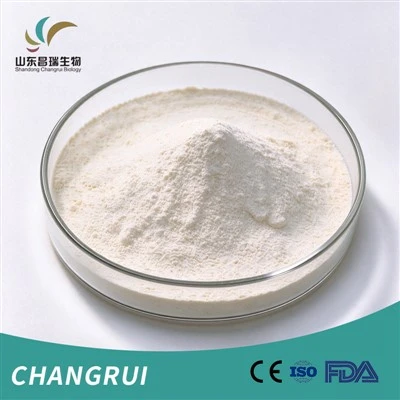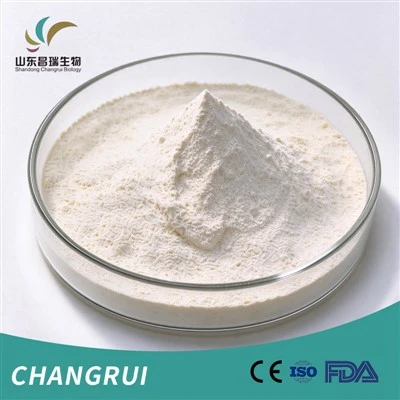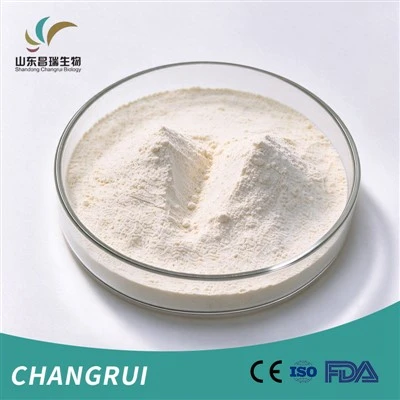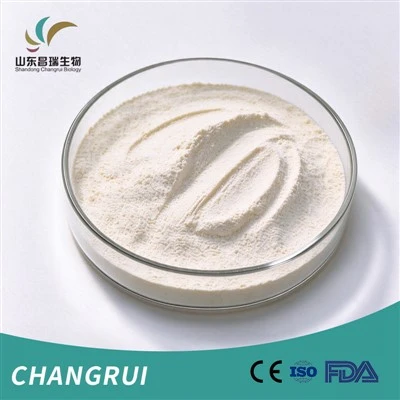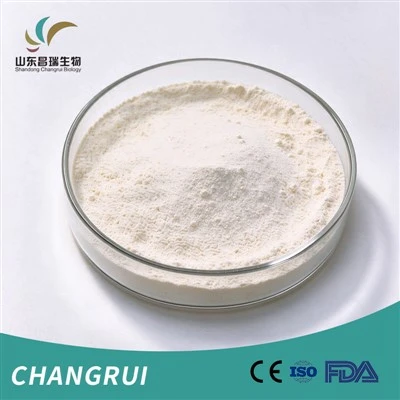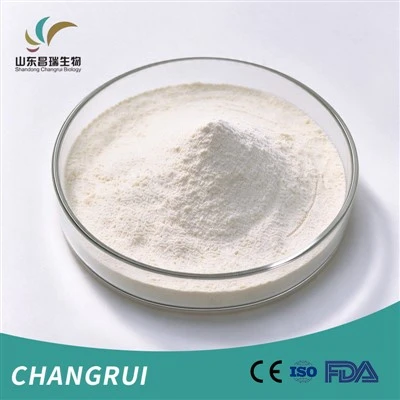
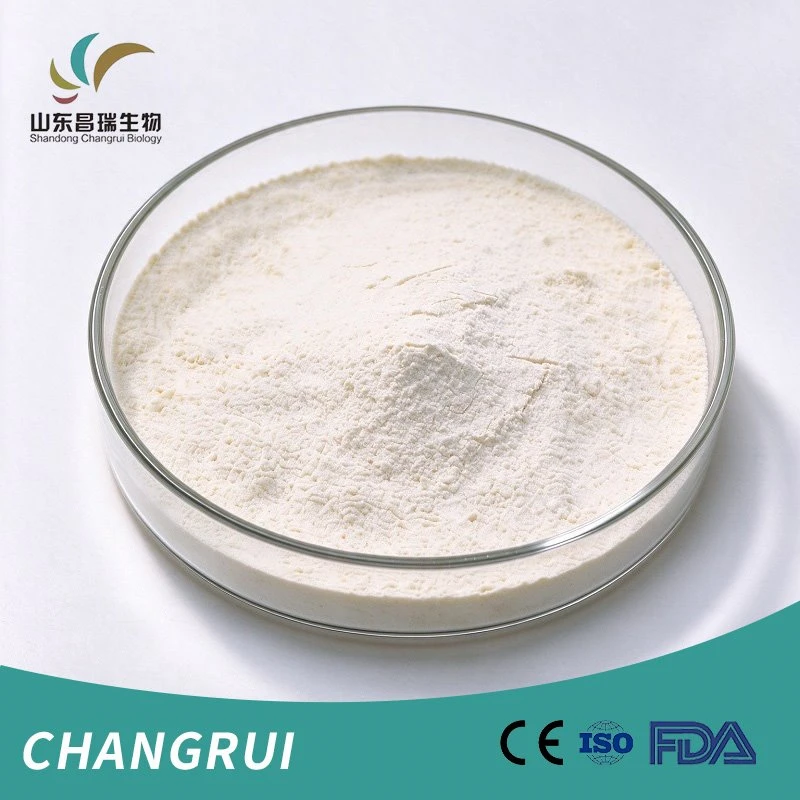
Shandong Changrui Biotech Co., Ltd. is one of the leading manufacturers and suppliers of chitosan hydrochloride powder in China. Please feel free to wholesale bulk high purity chitosan hydrochloride powder in stock here from our factory. All our raw materials are with high quality and competitive price. Contact us for pricelist.
Product Introduction
Chitosan Hydrochloride Powder is a strongly cationic water-soluble chitosan derivative produced via hydrochloric acid protonation. It serves as a dual-purpose raw material for pharmaceutical excipients and medical-device manufacturing. Boasting intrinsic water solubility and high positive-charge density, it brings distinctive aqueous-processing merits that conventional acid-soluble chitosan cannot offer, supporting diverse formulation and biomaterial development workflows.
Technical Specifications
|
Property |
Specification |
|
Appearance |
Pale yellow to off-white powder |
|
Assay |
99% min |
|
Deacetylation Degree |
80-95% |
|
Viscosity (1% solution, 20°C) |
2-200 mPa·s |
|
pH (1% solution) |
4.0-6.0 |
|
Moisture |
10.0% max |
|
Ash |
1.0% max |
|
Insoluble Matter |
0.5% max |
|
Heavy Metals (as Pb) |
40 PPM max |
|
Arsenic (As) |
1 PPM max |
|
Lead (Pb) |
10 PPM max |
|
Residual Protein |
0.2% max |
|
Cadmium (Cd) |
1 PPM max |
|
Total Plate Count |
1000 CFU/g max |
|
Mold & Yeast |
100 CFU/g max |
|
E. coli |
Negative |
|
Staphylococcus aureus |
Negative |
|
Pseudomonas aeruginosa |
Negative |
|
Salmonella |
Negative |
Health Benefits & Values
Direct Water Solubility Simplifies Aqueous Processing
This chitosan salt dissolves readily in water without dilute acid pre-treatment, cutting process complexity for liquid and coating formulations.
Strong Cationic Binding Enables Versatile Biocompatible Assembly
Positively charged chains bind to anionic biological surfaces, supporting hydrogel construction and mucosal interaction for drug delivery systems.
Built-In Broad-Spectrum Antimicrobial Performance
High cationic surface property disrupts microbial homeostasis, delivering inherent antibacterial effects for wound care and medical coating projects.
Flexible Film & Hydrogel Fabrication Capacity
Self-assembles into thin films and cross-linked hydrogels after hydration, ideal for tablet coating, injectable gels and custom 3D biomaterial scaffolds.
Safe & Degradable Biomaterial Foundation
Retains chitosan's superior biocompatibility and degrades into non-toxic fragments, fitting oral dosage and soft tissue-contact medical device development.
Core Value in Formulation Development
As Pharmaceutical Excipient
01 Hydrophilic Drug Carriers (Core): Oral delivery formulations developed for hydrophilic alkaloid-class bioactives and corresponding poorly-soluble actives.
02 Absorption Enhancers: Oral dosage forms aiming to elevate absorption of peptide-based and hydrophilic drug molecules.
03 Cationic Flocculants: Food-industry juice-clarification procedures and wastewater-treatment impurity-removal workflows.
04 Film Coating: Surface finishing operations for pharmaceutical tablets and granular intermediates.
05 Orally Disintegrating Tablets: Production of fast-disintegrating oral solid-dose finished goods.
As Medical Device Material
06 Antimicrobial Dressings: Manufacturing input for hydrogel and fibre-membrane wound-contact dressing products.
07 Injectable Hydrogels: Injectable in-situ gelling delivery systems and soft-tissue-filling biomaterial articles.
08 Hemostatic Materials: Raw material for hemostatic powder and sponge-type wound-care finished products.
09 Tissue Engineering Scaffolds: Scaffold fabrication for cartilage-repair and skin-repair regenerative-medicine projects.
10 Medical Antimicrobial Coatings: Surface treatment of catheters and stents for anti-biofilm functionalisation.
End-Application Scenarios
As Pharmaceutical Excipient
01 Hydrophilic Drug Carriers (Core): Oral delivery formulations developed for hydrophilic alkaloid-class bioactives and corresponding poorly-soluble actives.
02 Absorption Enhancers: Oral dosage forms aiming to elevate absorption of peptide-based and hydrophilic drug molecules.
03 Cationic Flocculants: Food-industry juice-clarification procedures and wastewater-treatment impurity-removal workflows.
04 Film Coating: Surface finishing operations for pharmaceutical tablets and granular intermediates.
05 Orally Disintegrating Tablets: Production of fast-disintegrating oral solid-dose finished goods.
As Medical Device Material
06 Antimicrobial Dressings: Manufacturing input for hydrogel and fibre-membrane wound-contact dressing products.
07 Injectable Hydrogels: Injectable in-situ gelling delivery systems and soft-tissue-filling biomaterial articles.
08 Hemostatic Materials: Raw material for hemostatic powder and sponge-type wound-care finished products.
09 Tissue Engineering Scaffolds: Scaffold fabrication for cartilage-repair and skin-repair regenerative-medicine projects.
10 Medical Antimicrobial Coatings: Surface treatment of catheters and stents for anti-biofilm functionalisation.
Application Advantages and Market Positioning
Convenient Aqueous-Processing Edge
Over 98 % water-solubility removes the requirement for dilute-acid solubilisation steps. It streamlines liquid-formula production and film-coating workflows, setting it apart from conventional acid-only-soluble chitosan grades.
Stand-Out High-Density Cationic Character
Within water-soluble chitosan derivative families, this salt variant exhibits high positive-charge density. This creates unique developmental options for absorption-boosting formula design and cation-driven purification-flocculation projects.
Multi-Faceted Utility for Pharma Formulators
Beyond acting as hydrophilic drug carriers and permeability-modifying additives, it can also serve flocculation needs and solid-dose surface-coating assignments in pharmaceutical and food-related processing.
Versatile Biomaterial Development Potential
Chitosan Hydrochloride Powder combined set of material properties expands design space for wound-care articles, injectable gel-systems and anti-biofilm surface-treated medical-device components.
FAQ (Technical Q&A)
As Pharmaceutical Excipient
Q1: How should Chitosan Hydrochloride be dissolved for formulation use?
A: Dissolve directly in water at 1%–5% w/v with stirring at room temperature. No acid required. Filter if clarity is critical.
Q2: How stable is the aqueous solution during processing?
A: Stable for short periods at pH 4–7. Avoid high temperature and alkaline conditions. Refrigerate at 2–8°C for longer processing.
Q3: Does it interact with anionic excipients or actives?
A: Yes, it may form complexes with anionic polymers or surfactants. Compatibility testing is recommended before scaling up.
Q4: What are the key considerations for film coating applications?
A: Dissolve in water, apply by spray or dip, then dry. Adding plasticizer such as glycerol improves film flexibility. Avoid high humidity during drying.
Q5: How does it perform in orally disintegrating tablets?
A: Its water solubility and cationic character support rapid disintegration. It also improves mouthfeel. Avoid excessive compression force.
Q6: What pH range is suitable for cationic flocculation?
A: Optimal flocculation occurs at pH 4–6 where the polymer carries strong positive charge. Performance decreases at alkaline pH.
As Medical Device Material
Q7: What are the gelation conditions for injectable hydrogels?
A: Gelation occurs via pH adjustment or ionic cross-linking at physiological pH. Gel time depends on concentration and cross-linker ratio.
Q8: How long does the antimicrobial effect last in wound dressings?
A: Antimicrobial activity persists as long as the polymer remains hydrated and cationic. Duration depends on dressing design and exudate level. Typical 24–72 hours.
Q9: What is the swelling ratio of hemostatic sponges made from this material?
A: Swelling ratio is typically 300%–800% depending on deacetylation degree and cross-linking. It can be tuned for different wound types.
Q10: Is Chitosan Hydrochloride Powder compatible with collagen or alginate in composite biomaterials?
A: Yes. It forms polyelectrolyte complexes. Test ratios for homogeneity, mechanical properties, and degradation profile.
Q11: Which sterilization methods are compatible?
A: Ethylene oxide and gamma irradiation are compatible. Both may reduce molecular weight; validate viscosity and mechanical properties after sterilization.
Q12: What pore size range is suitable for tissue engineering scaffolds?
A: 50–300 μm depending on tissue type. Pore size can be controlled by freeze-drying or porogen leaching.
Hot Tags: chitosan hydrochloride powder, China chitosan hydrochloride powder manufacturers, suppliers, factory