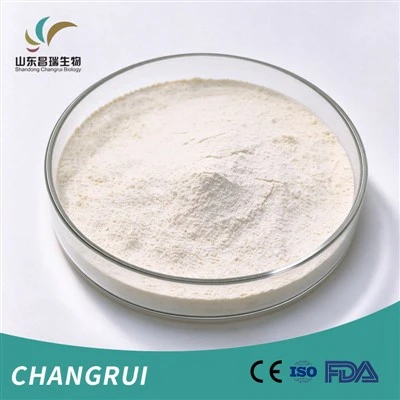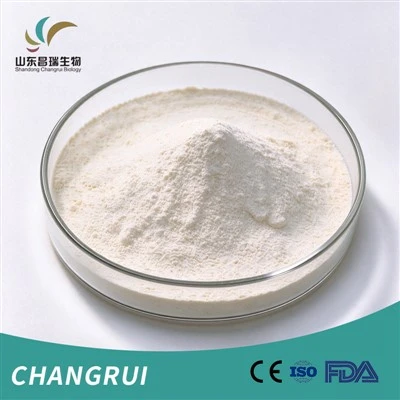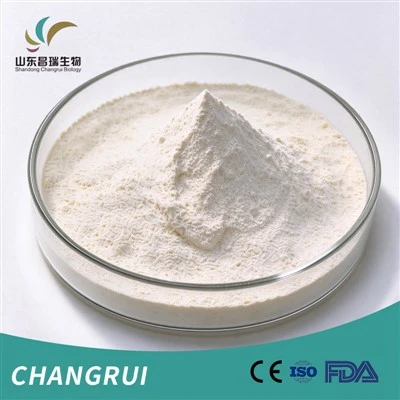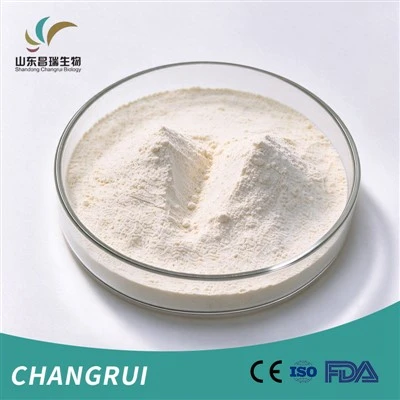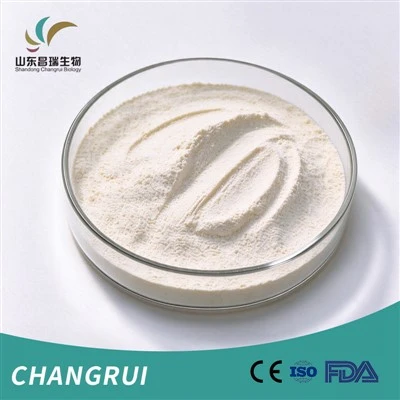
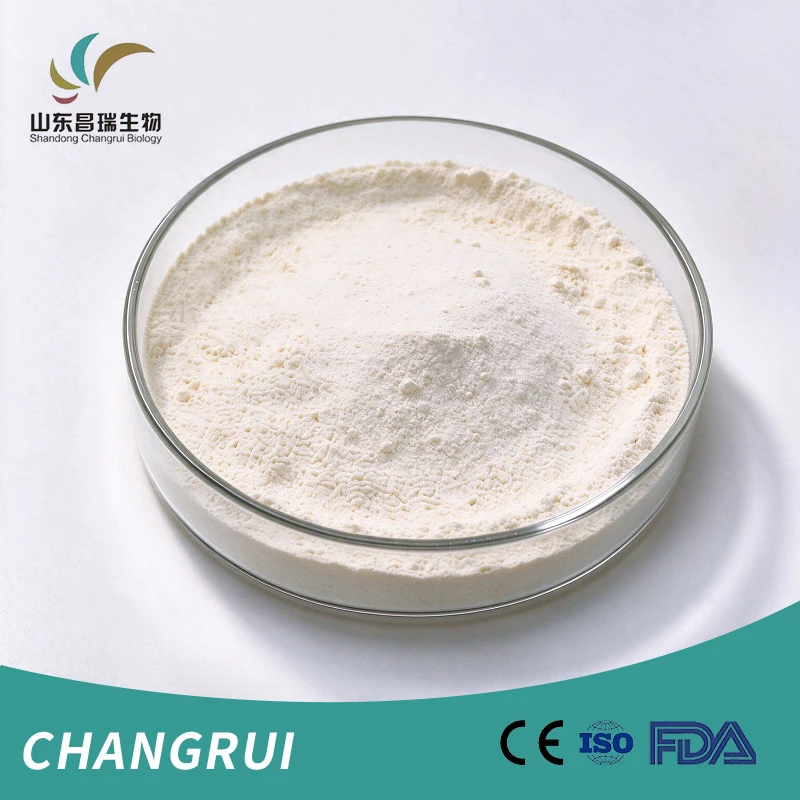
Shandong Changrui Biotech Co., Ltd. is one of the leading manufacturers and suppliers of quaternary chitosan in China. Please feel free to wholesale bulk high purity quaternary chitosan in stock here from our factory. All our raw materials are with high quality and competitive price. Contact us for pricelist.
Product Introduction
Quaternary Chitosan is obtained via targeted quaternization modification of natural chitosan raw material. Permanent cationic quaternary groups are grafted onto polysaccharide molecular chains to break the acid-soluble limitation of native chitosan. Produced under pharmaceutical-grade purification procedures, it controls heavy-metal, protein residue and microbial indicators to meet excipient filing requirements. Featuring prominent mucoadhesion, mild bacteriostatic property, film-forming performance and drug-carrying capacity, this derivative retains inherent biocompatibility and biodegradability of chitosan. As a key functional excipient raw material for pharmaceutical formulation development, it supports development of topical preparations, mucosal delivery systems and biomaterial substrates for pharmaceutical applications.
Technical Specifications
|
Property |
Specification |
|
Appearance |
Pale yellow to off-white powder |
|
Degree of Substitution |
70-90% |
|
Water Solubility |
100% soluble in water, stable at pH 3-10 |
|
Viscosity (0.5% acetic acid, 20°C) |
50-100 mPa·s |
|
Moisture |
10.0% max |
|
Ash |
1.0% max |
|
pH (1% Aqueous Solution) |
4.0-6.0 |
|
Insoluble Residue |
0.5% max |
|
Heavy Metals (as Pb) |
20 ppm max |
|
Arsenic (As) |
1.0 ppm max |
|
Executive Standard |
T/GSWS 029-2026 (Medical Grade) |
|
Biological Evaluation |
Compliant with GB/T 16886.1, GB/T 16886.5 |
Health Benefits & Values
Wide-Range pH Water-Soluble Performance
No acidic solvent required for dissolution, expands formulation options for neutral and weakly-alkaline pharmaceutical systems.
High-Efficiency Mucoadhesive Characteristic
Electrostatic binding with mucosal glycoproteins prolongs residence time of active agents on skin and mucosal surfaces to improve local bioavailability.
Mild Broad-Spectrum Bacteriostatic Effect
Positively-charged molecular chains disrupt microbial membrane permeability, lowering microbial contamination risk within preparation formulas.
Biocompatible & Biodegradable Property
Low-irritation to skin and mucosa; gradually degrades inside organism without persistent harmful residues.
Drug Encapsulation & Sustained-Release Capacity
Macromolecular network structure encapsulates pharmaceutical actives, mitigating sudden drug release and reducing local irritation.
Breathable Protective Film-Forming Ability
Forms flexible permeable barrier after coating, maintains gas exchange while providing physical protection for wound surfaces.
Safety Evaluation Data
Systemic safety evaluation in animal models: acute toxicity test showed good tolerance at 50× clinical dose (5.0 mg/mouse); repeated toxicity test in rats showed no pathological changes in organs; no allergic reactions in guinea pigs; no muscle ulceration or suppuration at injection sites in rabbits; no hemolysis. In vitro cytotoxicity: nearly non-toxic to human keratinocytes at 50 µg/mL, no cytotoxicity to L929 fibroblasts. Oral LD50 >5000 mg/kg (mouse).
Core Value in Formulation Development
Pharmaceutical-Grade Modified Polysaccharide Excipient Base Material
Strict impurity control for excipient registration; substitution degree adjustable according to formulation demands for varied viscosity and functional performance.
Versatile Formulation Matching
Quaternary Chitosan compatible with most neutral pharmaceutical auxiliary materials, thickeners and active pharmaceutical ingredients; avoid compounding with strong oxidizing substances.
Reliable Solution-Processing Adaptability
Complete dissolution without insoluble particles, suitable for manufacturing of gels, sprays, film-forming agents and dressing matrix.
Stable Functional Performance
Cationic activity will not decay with slight pH fluctuation, supporting long-term storage stability of finished pharmaceutical products.
Multifunctional Auxiliary Propertie
Provides thickening, suspending and film-forming functions in one excipient.
End-Application Scenarios
Topical Pharmaceutical Preparation Production (Core Track)
Used as core matrix raw material for wound film-forming agents, skin gels and mucosal sprays in pharmaceutical R&D and manufacturing.
Mucosal Drug-Delivery System Development
Applied to oral mucosal preparations for prolonged local drug action.
Functional Wound-Care Biomaterial Manufacturing
Serves as base substrate for medical wound dressings and tissue-engineering scaffold materials.
Pharmaceutical Formulation Auxiliary Additive
Used in liquid and semi-solid preparations to adjust rheological properties.
Pharmaceutical Coating Substrate Development
Used for surface functional coating of medical devices.
Application Advantages and Market Positioning
Quaternized Chitosan-Derived Excipient Positioning
Different from native pharmacopoeia-grade chitosan, this derivative offers formulation flexibility for neutral and weakly alkaline systems.
Integrated Multi-Functional Excipient Positioning
Reduces the number of auxiliary materials needed in formulation design.
Regulatory Documentation Support
Quaternary Chitosan provides test documents and batch-specific COA to support pharmaceutical excipient filing and registration.
Customization for Diverse Dosage Forms
Adjustable specifications to meet different formulation requirements.
FAQ (Technical Q&A)
Q1: How does Chitosan Quaternary Ammonium Salt differ from native chitosan in terms of charge properties?
A: Native chitosan carries pH-dependent positive charge and only dissolves in acid. This derivative has permanent quaternary ammonium groups, providing stable positive charge across pH 3–10 without acid solubilization.
Q2: What is the optimal degree of substitution for different dosage forms?
A: High substitution (70%–90%) gives stronger water solubility and bacteriostatic activity, suitable for sprays and film-forming agents. Medium-low substitution (30%–60%) provides higher viscosity, suitable for gels and sustained-release carriers.
Q3: Can it be used in formulations containing anionic excipients?
A: It may form complexes with anionic polymers or surfactants. Compatibility testing is recommended before scaling up. Avoid strong oxidizing agents.
Q4: What is the typical viscosity range of aqueous solutions?
A: Viscosity depends on degree of substitution and concentration. At 1% concentration, typical viscosity ranges from 10–200 mPa·s. Higher substitution grades generally show lower viscosity due to reduced chain entanglement.
Q5: How does it perform as a drug carrier for sustained release?
A: The macromolecular network encapsulates actives and slows release. Release rate can be tuned by substitution degree, concentration, and cross-linking. It also reduces local irritation from sudden drug release.
Q6: What is the recommended sterilization method for formulations containing this excipient?
A: Aseptic filtration is preferred for solutions. Autoclaving may reduce viscosity and molecular weight. Gamma irradiation may also affect performance. Validate sterility and viscosity after sterilization.
Q7: Does it have any preservative-boosting effect?
A: Its cationic chains disrupt microbial membranes, providing mild bacteriostatic activity. This can reduce preservative requirements in some formulations, but full preservative efficacy testing is still required.
Q8: What is the compatibility with common thickeners like carbomer or HPMC?
A: Compatible with non-ionic thickeners such as HPMC. With anionic carbomer, complexation may occur. Test compatibility and adjust pH if needed.
Q9: Can it be used for wound healing applications?
A: Yes. It forms breathable films, provides physical protection, and has mild bacteriostatic activity. It is suitable for wound dressings and tissue scaffolds.
Q10: What is the core market positioning of Quaternary Chitosan?
A: As a class II chitosan-derived pharmaceutical excipient raw material, it provides cationic polysaccharide functional components for topical preparations and drug-delivery systems. With the capacity for mucoadhesion, film formation, and auxiliary bacteriostasis, it acts as a premium multifunctional base material for developing pharmaceutical semi-solid preparations and medical biomaterials.
Hot Tags: quaternary chitosan, China quaternary chitosan manufacturers, suppliers, factory