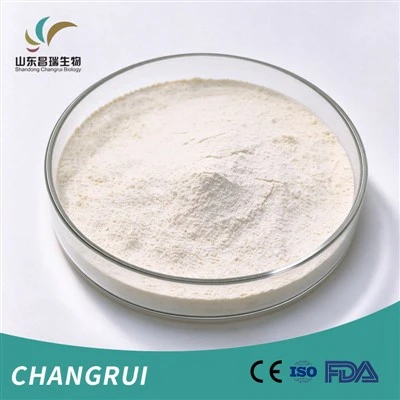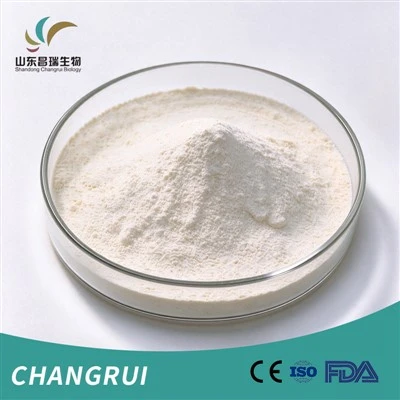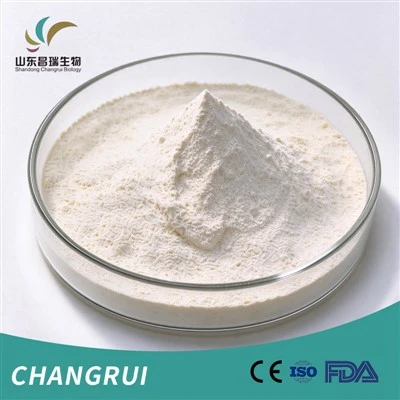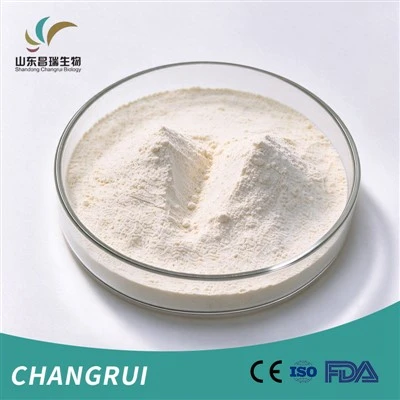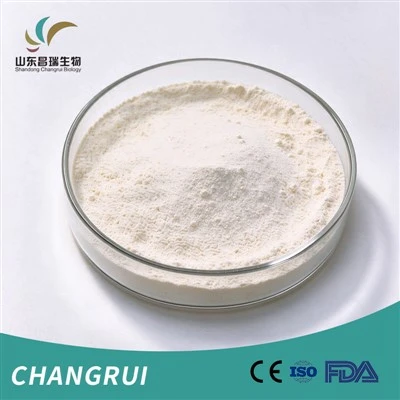
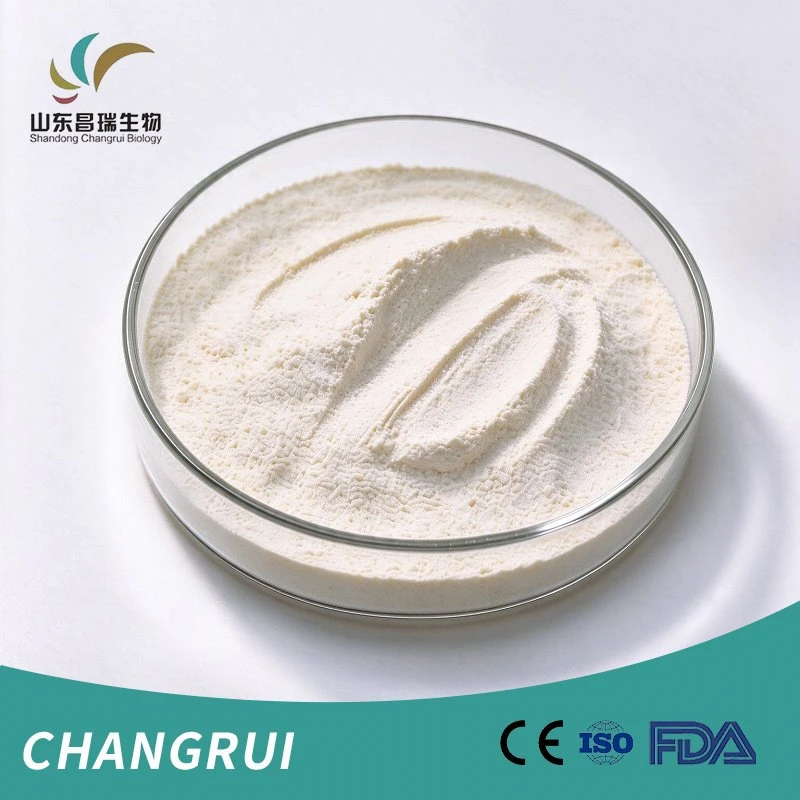
Shandong Changrui Biotech Co., Ltd. is one of the leading manufacturers and suppliers of thiolated chitosan in China. Please feel free to wholesale bulk high purity thiolated chitosan in stock here from our factory. All our raw materials are with high quality and competitive price. Contact us for pricelist.
Product Introduction
Thiolated Chitosan is a natural cationic thiolated polymer produced by covalently grafting thiol (-SH) groups onto the chitosan backbone. It applies to mucoadhesive drug delivery systems, transmucosal permeation enhancement, in situ gelling formulations, and nanoparticle carriers. Its core value lies in thiol-disulfide exchange to form covalent disulfide bonds with cysteine-rich domains of mucosal glycoproteins. It boosts mucoadhesive strength 6–100 times compared with unmodified chitosan and improves drug permeation through mucosal barriers, positioning it as a next-generation thiomer excipient combining strong mucoadhesion and permeation-enhancing properties.
Technical Specifications
|
Property |
Specification |
|
Appearance |
Pale yellow to off-white powder |
|
Thiol Content |
200-500 μmol/g |
|
Deacetylation Degree |
85% min |
|
Viscosity (0.5% acetic acid, 20°C) |
50-100 mPa·s |
|
Moisture |
10.0% max |
|
Ash |
1.0% max |
|
Insoluble Matter |
1.0% max |
|
Arsenic (As) |
1 PPM max |
|
Lead (Pb) |
10 PPM max |
|
Mercury (Hg) |
0.2 PPM max |
|
Cadmium (Cd) |
1 PPM max |
|
Total Plate Count |
1000 CFU/g max |
|
Mold & Yeast |
100 CFU/g max |
|
E. coli |
Negative |
|
Salmonella |
Negative |
Health Benefits & Values
Thiol Functional Groups Enable Strong Mucosal Binding
Reactive thiol sites form stable bonds with biological substrates, delivering far superior mucoadhesion compared to conventional chitosan derivatives.
Reversible Epithelial Barrier Regulation Enhances Permeation
Temporarily modulates epithelial barrier without permanent tissue damage, improving the penetration of large hydrophilic biomolecules.
pH-Triggered In-Situ Crosslinking for Local Gel Formation
Thiol groups undergo oxidative crosslinking under physiological pH to build gel networks, supporting site-specific sustained payload release.
Cationic Self-Assembly for Versatile Particle Encapsulation
Retained cationic backbone enables ionic crosslinking and self-assembly, suitable for micro/nanoparticle fabrication to encapsulate diverse active payloads.
Low-Irritation Biodegradable Biomaterial
Inherits excellent chitosan biocompatibility and can be degraded by lysozyme into non-toxic fragments, safe for mucosal contact delivery systems.
Core Value in Formulation Development
Extended Mucosal Residence Time
Thiolated Chitosan offers far longer retention on mucosal surfaces than standard chitosan, ideal for formulations requiring prolonged local contact.
Improved Bioavailability of Macromolecules
Enables enhanced absorption of large hydrophilic biomolecules, including peptides, proteins and vaccine payloads.
Local In-Situ Gelation at Mucosal Sites
Forms gel networks once applied to mucosal tissue, sustaining payload release at target sites.
Tunable Material Performance via Custom
Thiol Loading Thiol density can be adjusted from 200 to 500 μmol/g. Higher thiol content delivers stronger tissue affinity and faster crosslinking; lower thiol levels provide wider processing windows.
Good Compatibility with Common Excipients
Compatible with widely used excipients such as microcrystalline cellulose, lactose and hypromellose. Maintain processing pH below 5 to prevent premature thiol oxidation.
End-Application Scenarios
Mucoadhesive Drug Delivery Systems (Core Track)
Suitable for nasal sprays, buccal patches, eye drops and vaginal delivery systems. It extends payload retention on mucosal surfaces and improves absorption efficiency. Recommended dosage: 1%-10%.
Oral Peptide and Protein Drug Delivery
Designed for oral formulations of peptides, proteins and biomacromolecule vaccines to boost intestinal absorption.
In-Situ Gelling Formulations
Used for nasal and ophthalmic in-situ gel delivery platforms, to achieve sustained drug release at application sites.
Nanoparticle and Microsphere Drug Delivery Systems
Fabricated into mucoadhesive microspheres and nanoparticles for encapsulation of small molecules, proteins and genetic materials.
Supplementary Applications (Non-Pharmaceutical Excipient)
Can be used for tissue engineering scaffolds, wound dressings and bioadhesive biomaterial research.
Application Advantages and Market Positioning
Standout Mucosal Adhesion Performance
Outperforms common chitosan derivatives that rely only on weak electrostatic attraction, such as chitosan lactate.
Multi-Functional Single Excipient
Combines mucosal retention, barrier regulation and efflux inhibition in one raw material, simplifying excipient screening for complex biologic formulations.
Preferred Excipient for Biologic Formulation
Thiolated Chitosan is well suited for formulation development of peptide, protein and vaccine products for oral and transmucosal delivery routes.
Flexible Customization
Adjustable thiol content allows formulators to tailor adhesive strength and gelation speed to match different formulation designs.
FAQ (Technical Q&A)
Q1: How should it be dissolved for formulation use?
A: Dissolve in water or pH 3–5 acidic buffer at 0.5%–2% w/v with gentle stirring at room temperature. Maintain pH below 5 to prevent premature thiol oxidation.
Q2: How to control gelation time for in-situ gelling formulations?
A: Gelation is triggered by pH increase to physiological range. Gel time depends on thiol content, polymer concentration, and pH. Higher thiol content and higher pH accelerate gelation.
Q3: How stable is the aqueous solution during processing?
A: Stable at pH 3–5 for several hours. Above pH 5, thiol groups oxidize and cross-link. Prepare fresh or store refrigerated under inert atmosphere.
Q4: Does it interact with anionic excipients or actives?
A: Yes, it may form complexes with anionic polymers or drugs. Compatibility testing is recommended before scaling up.
Q5: What are the key considerations for nasal or buccal formulations?
A: Maintain pH 4–6 for optimal mucoadhesion. Sterile filtration is recommended for nasal applications. Avoid preservatives that may interact with thiol groups.
Q6: How does it perform in nanoparticle preparation?
A: Nanoparticles can be prepared by ionic cross-linking or self-assembly. Thiol content affects particle size and mucoadhesive properties. Typical size range: 100–400 nm.
Q7: How to protect thiol groups during storage?
A: Store sealed under inert gas or vacuum at 2–8°C, protected from light and moisture. Avoid alkaline conditions and oxidizing agents.
Q8: What is the compatibility with protein or peptide drugs?
A: It may bind proteins electrostatically and via disulfide exchange. Stability and conformation testing are required for each biologic.
Q9: Can Thiolated Chitosan be sterilized by autoclaving?
A: Not recommended. High heat may degrade thiol groups and reduce mucoadhesive performance. Use sterile filtration or aseptic processing.
Q10: How to control the degradation rate for mucosal delivery?
A: Degradation rate depends on deacetylation degree, molecular weight, and cross-linking density. Higher cross-linking slows degradation. Adjust these parameters to match the target residence time.
Q11: What is the typical thiol content range, and how does it affect performance?
A: 200–500 μmol/g. Higher thiol content increases mucoadhesion and gelation speed; lower content provides longer processing windows.
Q12: How to evaluate mucoadhesion performance in vitro?
A: Use porcine or bovine mucosal tissue with a texture analyzer or tensile tester. Measure detachment force and work of adhesion. Compare against unmodified chitosan as reference.
Hot Tags: thiolated chitosan, China thiolated chitosan manufacturers, suppliers, factory