Shandong Changrui Biotech Co., Ltd. is one of the leading manufacturers and suppliers of propiconazole technical in China. Please feel free to wholesale bulk high purity propiconazole technical in stock here from our factory. All our raw materials are with high quality and competitive price. Contact us for pricelist.
Product Introduction
As a systemic triazole agricultural fungicide, Propiconazole Technical inhibits ergosterol biosynthesis of pathogenic fungi. It exhibits upward systemic translocation inside plant tissues, featuring both protective and therapeutic activities. It controls a broad range of ascomycetes, basidiomycetes and deuteromycetes, tackling rust, powdery mildew, leaf spot and sheath blight on grains, fruits and vegetables. As a core technical raw material for foliar spray and seed treatment formulations, It helps growers suppress fungal disease outbreaks and stabilize crop yield.
Technical Specifications
|
Property |
Specification |
|
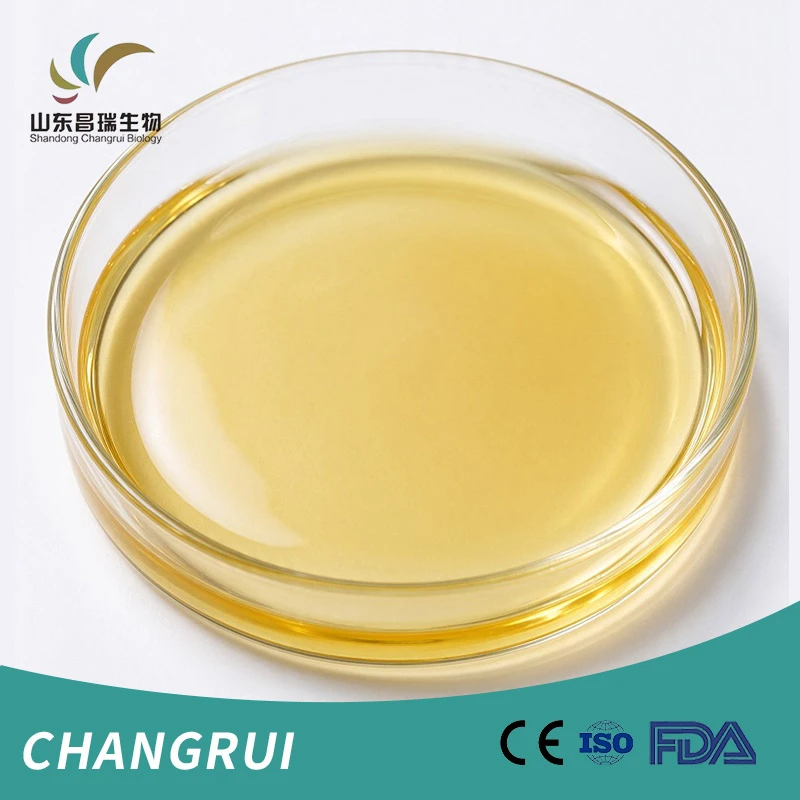
Appearance |
Pale yellow viscous liquid |
|
Active Ingredient Content |
≥95.0% |
|
Boiling Point |
180℃ (0.1 torr) |
|
Melting Point |
-23℃ (98.8% purity) |
|
Moisture |
≤0.5% |
|
Acidity (as H₂SO₄) |
≤0.3% |
|
Insoluble Residue |
≤0.2% |
|
pH Range |
5.0–7.0 |
|
Volatile Impurities |
Compliant with industrial technical standards |
Health Benefits & Values
Ergosterol Biosynthesis Inhibition (DMI)
Inhibits fungal CYP51 enzyme, blocking ergosterol synthesis and disrupting cell membrane formation, restraining mycelial growth and spore reproduction.
Systemic Acropetal Translocation
Absorbed by crop leaves and roots, transported upward through vascular tissues to protect newly emerging plant tissues.
Combined Protective & Curative Action
Inhibits established fungal infection and prevents fresh pathogen invasion, offering flexible disease control options for field use.
Broad Spectrum Against Multiple Fungal Classes
Effective against rust, powdery mildew, leaf spot and sheath blight caused by ascomycetes, basidiomycetes and deuteromycetes. Note: Not effective against oomycete pathogens.
High Purity Reduces Formulation Risks
Low impurity content lowers phytotoxicity risk and meets requirements for premium fungicide finished products.
Ecological Safety Considerations
Highly toxic to bees, silkworms, and aquatic organisms. Avoid application during flowering periods and near apiaries, mulberry fields, and water bodies.
Core Value in Formulation Development
High-Purity Technical Reduces Formulation Hazards
The ≥95% high-purity Propiconazole Technical adopts standardized purification process with low heavy metal and impurity content, lowering phytotoxicity risk and meeting requirements for premium fungicide finished products.
Formula Simplification for Multi-Disease Pressur
Single active ingredient addresses multiple fungal disease groups, reducing the need for multiple actives in finished formulations.
Multi-Dosage Form Process Adaptability
Suitable for emulsifiable concentrate, suspension concentrate, water dispersible granule and seed treatment formulations, matching foliar spraying and seed dressing workflows.
Good Potential for Compound Formulation
Compatible with many contact fungicides and different-mode-of-action actives. Combined formulas broaden disease spectrum and delay pathogen resistance development.
Consistent Storage Stability
Maintains reliable chemical stability under dry, shaded storage, resisting decomposition and preserving stable efficacy throughout finished product shelf life.
End-Application Scenarios
Foliar Fungal Disease Prevention (Core Track)
Controls rust, powdery mildew, leaf spot and sheath blight on wheat, corn, fruit trees, vegetables and commercial crops.
Seed Treatment Formulation
Processed into seed coating and seed dressing agents for early-season disease protection.
Long-Term Crop Disease Management
Applied in field and orchard spray programs to suppress recurring fungal diseases during the whole growing season.
Compound Fungicide Development
Used as core active ingredient for mixed fungicide formulations to expand control spectrum and mitigate resistance risk in long-term planting programs.
High-Value Orchard & Cash Crop Protection
Widely used for fruit trees, nuts and commercial grains, providing dependable multi-site fungal disease control for large-scale planting systems.
Application Advantages and Market Positioning
Broad-Spectrum Triazole Fungicide Differentiation
Different from narrow-spectrum fungicides, Propiconazole Technical covers multiple fungal taxonomic groups, serving as a versatile raw material for mixed-disease pressure scenarios.
Dual Preventive & Therapeutic Performance
Combines protective and therapeutic effects to deliver differentiated performance compared with contact fungicides, improving finished product market competitiveness.
Resistance Management Positioning
Suitable for rotation or tank-mix programs with multi-site fungicides to slow resistance development.
Wide Adaptability for Field & Orchard Crops
Features high efficiency and reliable crop safety within recommended rates, matching the disease control demands of grain fields and commercial orchards.
FAQ (Technical Q&A)
Q1: How does Propiconazole differ from other triazole fungicides like tebuconazole or difenoconazole?
A: Propiconazole has a broader spectrum against ascomycetes, basidiomycetes, and deuteromycetes compared to some narrow-spectrum triazoles. It exhibits strong acropetal translocation and is particularly effective against rust and sheath blight. Tebuconazole is more specific to Fusarium and smut diseases, while difenoconazole has stronger activity against powdery mildew and leaf spots.
Q2: What is the residual activity of Propiconazole on crops?
A: Residual activity typically lasts approximately one month under field conditions. This long residual makes it suitable for crops requiring extended disease protection. However, follow local label recommendations for application intervals.
Q3: Is Propiconazole toxic to bees and beneficial insects?
A: Yes. Propiconazole is highly toxic to bees and silkworms, and has a high risk to natural enemies such as Trichogramma. Avoid application during flowering periods and near apiaries, mulberry fields, and beneficial insect release areas.
Q4: Can Propiconazole be used to control oomycete diseases like late blight or downy mildew?
A: No. Propiconazole is effective against ascomycetes, basidiomycetes, and deuteromycetes, but is not effective against oomycete pathogens such as Phytophthora and Plasmopara. For oomycete diseases, use specific fungicides like dimethomorph or metalaxyl.
Q5: How does Propiconazole's translaminar activity compare to systemic fungicides?
A: Propiconazole has strong acropetal translocation, moving upward through vascular tissues to protect new growth. It does not move downward to roots after foliar application. This is different from truly systemic fungicides that can move in both directions.
Q6: What is the optimal pH range for tank-mixing Propiconazole with other agrochemicals?
A: Propiconazole is stable under neutral and weakly acidic conditions (pH 5.0–7.0). Avoid mixing with strongly alkaline pesticides (pH > 8) to prevent decomposition and efficacy loss. A small-scale jar test is recommended before large-volume mixing.
Q7: Can Propiconazole be used as a seed treatment for all crops?
A: Propiconazole is registered for seed treatment on wheat, barley, and other cereals to control seed-borne and soil-borne fungal pathogens. Follow local registration guidelines for specific crops. It is not recommended for crops where oomycete diseases are the primary concern.
Q8: How should Propiconazole be stored to maintain stability?
A: Store in a sealed container in a cool, dry, ventilated warehouse away from heat, direct sunlight, and fire sources. Propiconazole is stable for at least 2 years under proper storage conditions. Avoid temperatures above 320°C, as decomposition may occur.
Q9: What is the difference between it and Propiconazole finished formulations?
A: It is a raw material for pesticide manufacturers to produce finished formulations such as EC, SC, and seed treatment products. Finished formulations are ready-to-use products that require dilution before field application.
Q10: Does Propiconazole have any plant growth regulatory effects?
A: Yes, like other triazole fungicides, Propiconazole Technical can exhibit plant growth regulatory effects when applied at certain rates. It may cause slight growth retardation in some crops, which is usually temporary and recovers after application. This is an important consideration for crop safety and application timing.
Hot Tags: propiconazole technical, China propiconazole technical manufacturers, suppliers, factory